Suguru · EN
Suguru for Beginners: Region Singles and Neighbour Checks
Begin Suguru by listing each region's missing numbers and removing the digits already present in every cell's eight neighbours. Fill a cell with one candidate or a region digit with one possible position, then update both the region and the surrounding cells.
Map the regions and keep givens fixed
Follow the thick borders and count each outlined shape. Its size defines the full set of digits it needs. In the current GooferThings puzzle every region has five cells and therefore uses 1–5. General Suguru boards can have smaller regions with smaller allowed sets.
Identify the given entries before taking notes. They are confirmed starting information. For each region, list only the digits still missing; this provides a quick reference and prevents an already used number from slipping into a distant part of the same irregular shape.
First deduction: eliminate touching digits
Choose an empty cell and inspect all neighbouring positions, including corners. Remove each visible neighbour's digit from the cell's allowed region set. Then remove digits used anywhere else in the same region, even if those entries are not close to the chosen square.
These are two different checks. A faraway entry matters because it shares the region; an entry across a thick border matters because it touches. Use both before deciding a number fits, and repeat the neighbourhood check after every confirmed entry.
Second deduction: find a cell single
When one candidate remains in a cell, enter it. This is often called a naked single. The proof is that every other member of its region set has been excluded by a used region digit or a touching equal digit.
Immediately remove the entered digit from the rest of its region and all touching cells. Do not restrict the update to the row and column. Diagonal neighbours are equally important and often create the next single in another region.
Third deduction: find a region single
Choose one missing digit and inspect all empty cells of its region. If only one can hold it, place it there even when that cell still has other candidates. This is a hidden single: the digit needs a home and has only one possible address.
Scan by digit as well as by cell. A board can have no one-candidate cells yet still have a forced region digit. Suguru's whole-row and whole-column counts do not offer the same requirement, so use this search within outlined regions only.
Fourth deduction: complete nearly finished regions
A region with one empty cell takes its last missing digit. With two empty cells, note the two missing values and use touching neighbours to determine their order. Knowing the pair does not automatically tell you which cell holds which value.
If neither position is decided, retain both possibilities and move elsewhere. A confirmed digit in a neighbouring region may settle their order later. This habit keeps useful partial progress while avoiding a guess merely to finish a shape.
Start with this easy puzzle
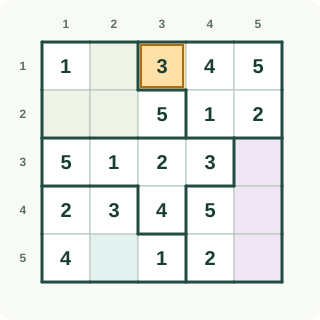
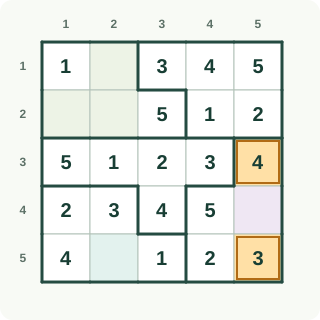
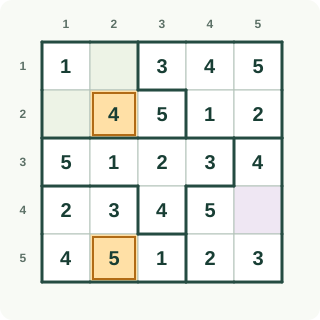
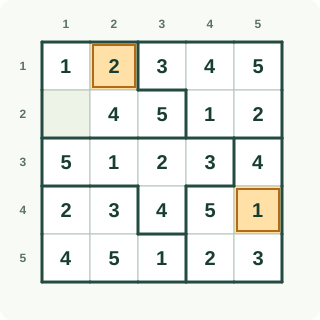
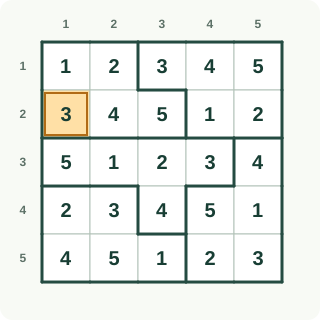
Thick outlines mark regions. Orange outlines show new digits; equal digits are excluded from all eight neighboring cells. Tinted squares remain undecided.
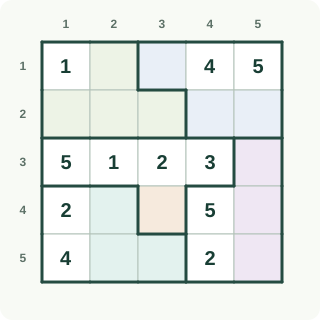
Step 1: Remove touching digits
Remove digits already touching each square, including diagonally. The remaining candidates force these two placements; other comparisons narrow candidates for later checks. Write R2C3=5, R2C4=1.
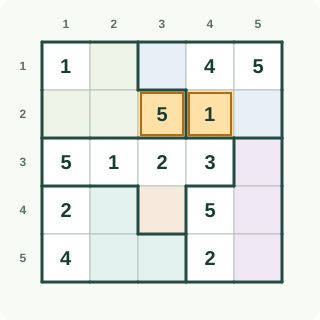
Step 2: Check all eight neighbors
Continue checking all eight neighbors. Existing digits eliminate every alternative in these two cells, while nearby cells retain smaller candidate sets for later use. Write R4C2=3, R4C3=4.
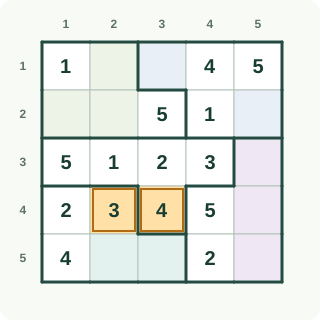
Step 3: Combine neighbors with region gaps
Combine neighbor exclusions with each region’s missing digits. The lower forced 1 and the last available position in the upper region are now forced. Write R5C3=1, R2C5=2.
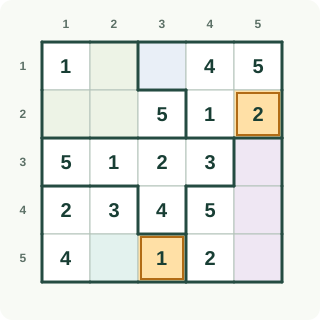
Step 4: Complete the upper-right region
The outlined upper-right region must contain 1–5 exactly once. Its remaining missing digit has only this cell available after all the earlier placements. Write R1C3=3.
Step 5: Resolve the right-hand region
In the right-hand region, remove digits already used inside the boundary. The two remaining positions are fixed by their neighboring digit restrictions. Write R3C5=4, R5C5=3.
Step 6: Use the new diagonal exclusions
Complete the lower-left region’s missing digit, then revisit cells touching the new placements. The resulting diagonal exclusions resolve the next upper-left cell. Write R5C2=5, R2C2=4.
Step 7: Find the last regional positions
The right-hand cell cannot copy a touching 4, while the upper-left region has only one position left for its remaining missing 2. Write R4C5=1, R1C2=2.
Step 8: Finish and check every contact
The last cell in the upper-left region must take its only missing digit. Finish by checking both region uniqueness and every diagonal neighbor. Write R2C1=3.
Read the easy example as a sequence of updates
At each illustrated step, identify the relevant region and the neighbours that exclude candidates. Before looking at the next diagram, explain whether the entry follows from a cell single, a digit with one region position, or a final missing digit.
After placing the number, predict which nearby cells changed. The strongest beginner habit is following the consequences across borders instead of solving regions in isolation. A single digit can remove candidates from several shapes at once and start a chain around the board.
Recover a stalled solve and check completion
Rebuild notes around your most recent entry, then scan nearly complete regions and missing digits with few available homes. If a cell has no candidates, check for a missed diagonal restriction or an earlier entry made without a firm reason. Undo the unsupported choice before rebuilding notes.
Finish with separate region-set and touching-pair checks. Puzzler's own Suguru instructions supply the primary rule reference and credit Naoki Inaba. Play Suguru free to practise again, read the rules guide for details, or continue to solving strategies for pairs and common-neighbour reasoning.
Sources and background
Worked example: follow each deduction
Read rows from top to bottom and columns from left to right, starting at 1. Read each instruction, then compare the orange changes with the previous picture. Keep undecided cells or segments open until the explanation settles them.
? = undecided
Follow these changes in order; the picture below includes all of them.
Write 5 at row 2, column 3. The squares at row 2, column 3 and row 3, column 4 touch, so they must have different digits, even across a region boundary or a diagonal. The settled neighbour excludes the other choice here.
Write 1 at row 2, column 4. The squares at row 2, column 4 and row 3, column 4 touch, so they must have different digits, even across a region boundary or a diagonal. The settled neighbour excludes the other choice here.
Step 1: the orange outlines mark the changes explained above. Follow these changes in order; the picture below includes all of them.
Write 3 at row 4, column 2. The squares at row 4, column 2 and row 5, column 1 touch, so they must have different digits, even across a region boundary or a diagonal. The settled neighbour excludes the other choice here.
Write 4 at row 4, column 3. The squares at row 4, column 3 and row 4, column 4 touch, so they must have different digits, even across a region boundary or a diagonal. The settled neighbour excludes the other choice here.
Step 2: the orange outlines mark the changes explained above. Follow these changes in order; the picture below includes all of them.
Write 1 at row 5, column 3. The squares at row 5, column 3 and row 5, column 4 touch, so they must have different digits, even across a region boundary or a diagonal. The settled neighbour excludes the other choice here.
Write 2 at row 2, column 5. the outlined region containing row 1, column 3 already contains 1, 4, 5. Repetition is forbidden there. From this square’s remaining choices 1, 2, only 2 survives.
Step 3: the orange outlines mark the changes explained above. Follow these changes in order; the picture below includes all of them.
Write 3 at row 1, column 3. the outlined region containing row 1, column 3 still needs 3. Every other position in that unit has ruled it out, so this is its only remaining place.
Step 4: the orange outlines mark the changes explained above. Follow these changes in order; the picture below includes all of them.
Write 4 at row 3, column 5. the outlined region containing row 3, column 5 already contains 2, 5. Repetition is forbidden there. From this square’s remaining choices 2, 4, only 4 survives.
Write 3 at row 5, column 5. the outlined region containing row 3, column 5 still needs 3. Every other position in that unit has ruled it out, so this is its only remaining place.
Step 5: the orange outlines mark the changes explained above. Follow these changes in order; the picture below includes all of them.
Write 5 at row 5, column 2. the outlined region containing row 4, column 1 already contains 1, 2, 3, 4. Repetition is forbidden there. From this square’s remaining choices 1, 5, only 5 survives.
Write 4 at row 2, column 2. The squares at row 1, column 3 and row 2, column 2 touch, so they must have different digits, even across a region boundary or a diagonal. The settled neighbour excludes the other choice here.
Step 6: the orange outlines mark the changes explained above. Follow these changes in order; the picture below includes all of them.
Write 1 at row 4, column 5. The squares at row 3, column 5 and row 4, column 5 touch, so they must have different digits, even across a region boundary or a diagonal. The settled neighbour excludes the other choice here.
Write 2 at row 1, column 2. the outlined region containing row 1, column 1 already contains 1, 4, 5. Repetition is forbidden there. From this square’s remaining choices 2, 4, only 2 survives.
Step 7: the orange outlines mark the changes explained above. Follow these changes in order; the picture below includes all of them.
Write 3 at row 2, column 1. the outlined region containing row 1, column 1 still needs 3. Every other position in that unit has ruled it out, so this is its only remaining place.
Step 8: the orange outlines mark the changes explained above.
Frequently asked questions
What is the easiest Suguru technique?
Candidate elimination followed by a cell single. Start with the region's allowed set, remove used region digits and all touching digits, and enter a number only when one possibility remains.
What if no cell has a single candidate?
Look at one missing digit across a whole region. It may have only one possible position, giving a hidden single even when that cell's notes still contain other numbers.
Should I check every cell in the row after an entry?
Update the entry's full region and its immediate eight-neighbour area. A distant cell in the same row has no special restriction unless it shares the region. Avoid importing Sudoku's row rule.
Which related puzzle helps with candidate notes?
Sudoku and Futoshiki also reward careful elimination, though their row and column requirements differ. Star Battle reinforces the habit of checking diagonals across outlined regions.