Suguru · EN
Suguru Solving Strategies: Singles, Pairs and Common Neighbours
Solve harder Suguru grids by combining region candidates with the equal-digits-cannot-touch rule, especially at diagonals between shapes. After singles, use locked candidate groups and common-neighbour exclusions to remove possibilities before any individual cell is decided.
Build complete candidate sets
For each cell, begin with 1 through its region's size. Remove digits already used in the region and digits in all touching cells, including diagonals. The current GooferThings board uses five-cell regions, but the same process works for smaller regions in other publications.
Keep notes complete rather than recording only likely values. A pair or a hidden single is valid only when the candidate set reflects every remaining possibility. If a candidate was omitted without proof, a later advanced deduction may look rigorous while resting on that earlier mistake.
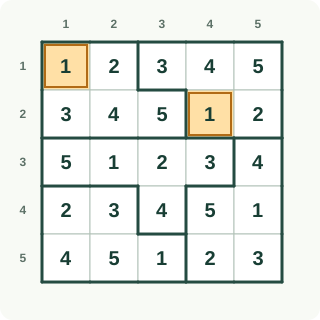
Alternate naked singles and region hidden singles
A naked single is a cell with one candidate. A hidden single is a missing region digit with only one possible cell. Scan in both directions: from cells to digits, then from each required digit to its available homes in the outlined region.
After an entry, update the entire region and all touching cells. A region single can remove a diagonal candidate in another shape, causing a cell single there. Following these chains is often enough to resolve a section that initially appears to require an advanced pattern.
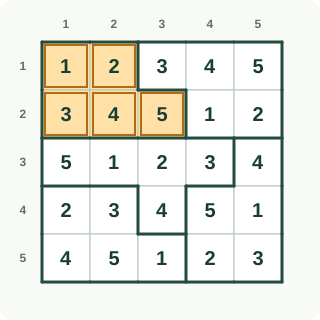
Naked pairs within a region
If two cells in one region both have exactly the same two candidates, those two digits must occupy the pair in some order. Remove both digits from every other cell in that region. You do not need to know which member goes in which cell.
The proof relies on those two cells having no additional candidate and on the region's no-repeat rule. Two cells that merely include the same pair among larger sets are not a naked pair. After eliminating candidates, check for newly created cell singles and region singles.
Common-neighbour exclusion for a confined digit
Suppose a required region digit can occupy only two cells. Any outside cell that touches both of those positions cannot contain that digit: whichever position eventually holds it would create a touching equal pair. The two possible positions themselves may remain unresolved.
This is particularly useful around irregular borders and diagonal contacts. Identify every remaining home of the digit before using it. If a third possible region cell exists and does not touch the outside target, the exclusion has not been proved.
All-different groups around a 2×2 square
The four cells of a 2×2 square all touch one another, through a side or a corner. Their four digits must therefore be different, even when the square crosses several regions. Candidate pairs can eliminate values from the other cells of this tightly connected group.
Apply the same counting care as within a region. If two cells of the square are confined to two digits, the other two cannot use either digit. Do not extend that exclusion to a cell that touches only one member of the pair unless another rule supplies the missing conflict.
Hidden pairs and region-position reasoning
Two missing digits confined to the same two cells of a region form a hidden pair. Those cells must contain the two digits, so remove any other candidates from them. This differs from a naked pair: you discover it by looking at digit positions rather than already-small cell sets.
Once a hidden pair is established, its two cells may also constrain common neighbours outside the region. Transfer only deductions supported by the exact candidate or position group. An outlined shape does not impose Sudoku-style restrictions on an entire row or column.
Short contradiction chains with an explicit endpoint
If direct eliminations stall, test a constrained candidate and follow forced region and neighbour updates. A cell losing all candidates, a region digit losing every possible home, or two confirmed touching equals disproves the assumption. State the precise failure instead of describing the branch as unpromising.
Record the initial assumption and undo all dependent entries before continuing. A contradiction can prove an exclusion; a branch that merely stalls cannot. Prefer a choice near a nearly completed region so its consequences stay short enough to inspect reliably.
A harder worked example
This board uses the Hard preset. Follow the four cumulative stages, revisiting each affected constraint after a deduction. Thick outlines mark regions. Orange outlines show new digits; equal digits are excluded from all eight neighboring cells. Tinted squares remain undecided.
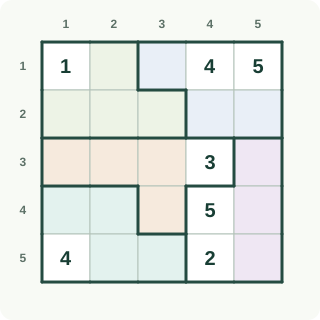
Worked stage 1
Combine region missing digits with exclusions from all eight neighboring cells. When two candidates remain, test the smaller possibility: its propagated equal digits would touch. Reject that branch and carry the surviving placement into the adjoining region.
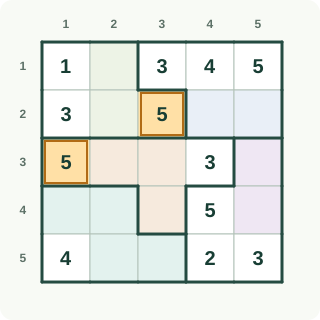
Worked stage 2
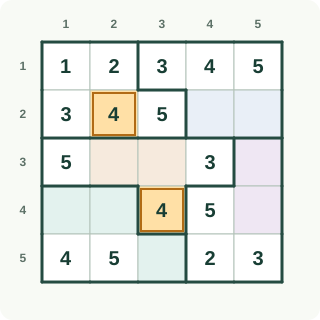
Use the new neighbor exclusions to reduce the lower regions. Test the uncertain upper-left digit against region completeness; the rejected branch leaves a region without a legal missing digit. Keep the surviving value and propagate its diagonal effects.
Worked stage 3
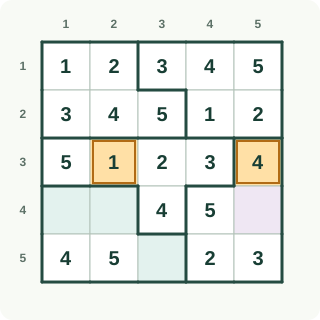
Test the remaining upper-middle alternative against the lower-left region’s required digits. Its failure forces the smaller value there. Neighbor exclusions then fix the adjacent cells, and the middle region’s remaining digits settle the next placements.
Worked stage 4
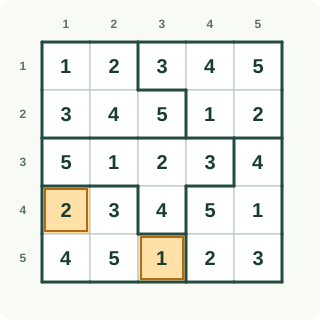
Finish by propagating the newly fixed values through their eight-cell neighborhoods. The last lower-region positions each have a single candidate. Check that every outlined region contains 1–5 and that equal digits never touch across a region boundary.
Sources and background
Worked example: follow each deduction
Read rows from top to bottom and columns from left to right, starting at 1. Read each instruction, then compare the orange changes with the previous picture. Keep undecided cells or segments open until the explanation settles them.
? = undecided
Follow these changes in order; the picture below includes all of them.
Write 3 at row 1, column 3. the outlined region containing row 1, column 3 still needs 3. Every other position in that unit has ruled it out, so this is its only remaining place.
Write 3 at row 5, column 5. the outlined region containing row 3, column 5 still needs 3. Every other position in that unit has ruled it out, so this is its only remaining place.
Write 3 at row 2, column 1. the outlined region containing row 1, column 1 still needs 3. Every other position in that unit has ruled it out, so this is its only remaining place.
Write 5 at row 2, column 3. This is a trial-and-contradiction step. Temporarily try 2 here and continue the rules from the current grid. Every continuation fails: the touching squares at row 2, column 2 and row 3, column 3 cannot keep different digits. Undo that trial and use the stated choice.
Write 5 at row 3, column 1. the outlined region containing row 3, column 1 still needs 5. Every other position in that unit has ruled it out, so this is its only remaining place.
Step 1: the orange outlines mark the changes explained above. Follow these changes in order; the picture below includes all of them.
Write 5 at row 5, column 2. the outlined region containing row 4, column 1 still needs 5. Every other position in that unit has ruled it out, so this is its only remaining place.
Write 2 at row 1, column 2. This is a trial-and-contradiction step. Temporarily try 4 here and continue the rules from the current grid. Every continuation fails: the outlined region containing row 3, column 1 cannot contain every required digit exactly once. Undo that trial and use the stated choice.
Write 4 at row 2, column 2. The squares at row 1, column 2 and row 2, column 2 touch, so they must have different digits, even across a region boundary or a diagonal. The settled neighbour excludes the other choice here.
Write 4 at row 4, column 3. the outlined region containing row 3, column 1 still needs 4. Every other position in that unit has ruled it out, so this is its only remaining place.
Step 2: the orange outlines mark the changes explained above. Follow these changes in order; the picture below includes all of them.
Write 1 at row 2, column 4. This is a trial-and-contradiction step. Temporarily try 2 here and continue the rules from the current grid. Every continuation fails: the outlined region containing row 4, column 1 cannot contain every required digit exactly once. Undo that trial and use the stated choice.
Write 2 at row 2, column 5. The squares at row 2, column 4 and row 2, column 5 touch, so they must have different digits, even across a region boundary or a diagonal. The settled neighbour excludes the other choice here.
Write 2 at row 3, column 3. The squares at row 2, column 4 and row 3, column 3 touch, so they must have different digits, even across a region boundary or a diagonal. The settled neighbour excludes the other choice here.
Write 4 at row 3, column 5. The squares at row 2, column 4 and row 3, column 5 touch, so they must have different digits, even across a region boundary or a diagonal. The settled neighbour excludes the other choice here.
Write 1 at row 3, column 2. The squares at row 3, column 2 and row 3, column 3 touch, so they must have different digits, even across a region boundary or a diagonal. The settled neighbour excludes the other choice here.
Step 3: the orange outlines mark the changes explained above. Follow these changes in order; the picture below includes all of them.
Write 3 at row 4, column 2. The squares at row 3, column 3 and row 4, column 2 touch, so they must have different digits, even across a region boundary or a diagonal. The settled neighbour excludes the other choice here.
Write 1 at row 4, column 5. The squares at row 3, column 5 and row 4, column 5 touch, so they must have different digits, even across a region boundary or a diagonal. The settled neighbour excludes the other choice here.
Write 2 at row 4, column 1. The squares at row 4, column 1 and row 4, column 2 touch, so they must have different digits, even across a region boundary or a diagonal. The settled neighbour excludes the other choice here.
Write 1 at row 5, column 3. The squares at row 4, column 2 and row 5, column 3 touch, so they must have different digits, even across a region boundary or a diagonal. The settled neighbour excludes the other choice here.
Step 4: the orange outlines mark the changes explained above.
Frequently asked questions
Can a Suguru pair affect another region?
Yes, through actual touching relationships. A digit confined to two cells excludes that digit from an outside cell touching both. Check every possible home before claiming the shared-neighbour exclusion.
Are four cells in a 2×2 square all different?
Yes. Each pair touches by a side or a corner, so equal digits would violate the neighbour rule. The square can cross region borders; those borders do not cancel the touching restriction.
What is the difference between naked and hidden pairs?
A naked pair starts with two cells containing only the same two candidates. A hidden pair starts with two region digits whose only homes are the same two cells. Both reserve those positions for those digits.
What should I verify before using advanced candidates?
Check that notes include every legal value and exclude only values with a clear reason. Reinspect diagonals and used region digits. Advanced deductions cannot repair a candidate that was silently omitted earlier.