Star Battle · EN
How to Play Star Battle: Rules Explained
To play Star Battle, place the required number of stars in every row, every column and every outlined region, with no stars touching through an edge or a corner. GooferThings uses a 6×6 one-star puzzle, so each of those groups must contain exactly one star.
Read the star quota before solving
The quota is the number of stars required in each row, column and region. Here it is one. Every completed row therefore contains one star and five cells without stars; the same is true of every column. With six rows, the entire board contains six stars. Counting the regions gives the same total, because each cell belongs to exactly one outlined region.
Elsewhere you may encounter two-star puzzles, often under the newspaper name Two Not Touch. The placement and touching principles are similar, but a row needing two stars behaves differently from a row needing one. Always read the displayed quota before borrowing a deduction from another puzzle. Region size never changes the quota: a large region here still requires exactly one star.
Apply all three counting rules together
A star belongs simultaneously to a row, a column and a region. Placing it satisfies all three groups. Every other cell in its row, every other cell in its column and every other cell in its region must then be excluded. A cell excluded for several reasons needs only one mark, but remembering those reasons can help when checking a deduction.
The region outlines are fixed clues. They do not form paths, and you do not draw new regions. An irregular region can cross several rows and columns; trace its full boundary before counting possible positions. Solving only the rows is insufficient: a board with one star in each row may still repeat a column or leave an entire region empty.
Remember that corners count as touching
Stars cannot occupy neighboring cells horizontally, vertically or diagonally. Imagine the eight cells immediately around a star: every existing cell in that neighborhood must remain star-free. The board edge simply shortens that neighborhood; it does not make the grid wrap around. Stars at opposite edges do not touch unless their actual cells are neighbors on the board.
In a one-star puzzle, the row and column rules already prohibit horizontal or vertical neighbors in the same line. The diagonal restriction adds an essential extra condition between adjacent rows. Checking region quotas without checking diagonals is a frequent source of almost-correct solutions. A region border never protects two touching stars from this rule.
Use exclusion marks as information
An empty-looking cell can mean either undecided or definitely not a star. Distinguish those states while solving. When a row, column or region has only one possible star position left, that position is forced. This is a last-position deduction, and it works only if every excluded alternative has a valid reason.
You do not need to know which cell holds a region's star to learn something about nearby cells. If every remaining position in that region would touch a particular outside cell, that outside cell cannot contain a star. The useful fact is shared by all alternatives. It does not authorize choosing one of the region's positions prematurely.
Avoid the most common rule mistakes
Do not place one star in each connected-looking patch of blank cells. The printed outlines define the regions, regardless of the exclusions you add. Nor does a region require one star per row it crosses. Its one-star allowance covers the whole region, and filling it excludes its remaining cells even when they lie far away from the star.
A square block of four cells can contain at most one star because every pair of cells in that block shares an edge or corner. This is a consequence of the touching rule, not an extra region rule. Keep local spacing and group quotas separate: a cell may have plenty of space around it yet be forbidden because its column is already complete.
A brief note on Star Battle's background
The official instruction booklet for the 2003 World Puzzle Championship in the Netherlands already includes Star Battle in its two-star form. The World Puzzle Federation's 2015 Grand Prix booklet later credits its entries to Richard Stolk and Hans Eendebak. These primary tournament documents trace the competition tradition behind the smaller one-star version here.
A solved example: check every rule
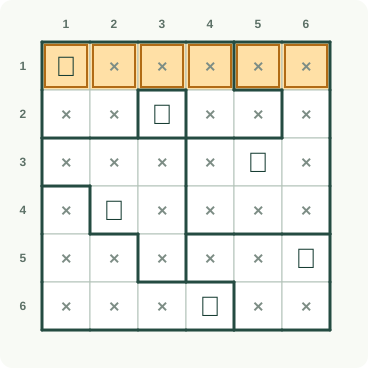
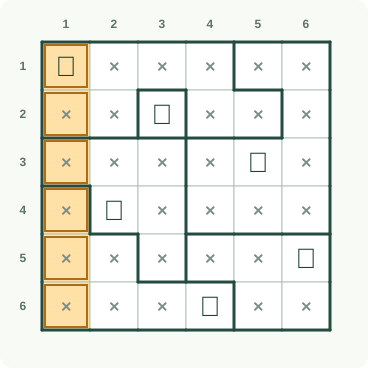
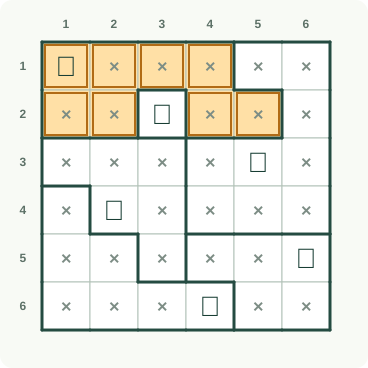
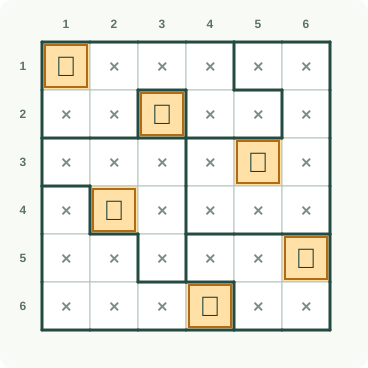
This completed example satisfies every puzzle rule. The individual highlights below identify the cells or edges that demonstrate each rule.
A star is a placement; a cross is a confirmed empty cell. Thick lines mark regions and orange outlines identify the latest decisions. Tinted squares remain undecided.
Sources and background
Frequently asked questions
Can stars touch diagonally in Star Battle?
No. Two stars cannot share an edge or a corner, even when they belong to different outlined regions. Check the cells immediately diagonally above and below each star as well as its horizontal and vertical neighbors.
Is Star Battle the same as Two Not Touch?
Two Not Touch is a name associated with the two-star form of this puzzle. GooferThings uses one star in every row, column and region. Read the quota before applying a technique, because two-star counting deductions need adjustment.
Does every region have to be the same size?
No. Outlined regions can have different sizes and irregular shapes. Each still receives the same stated number of stars. A small region often offers fewer possible positions, but its appearance alone does not decide where its star belongs.