Hitori · EN
How to Play Hitori: Rules Explained
To solve Hitori, shade cells so each number appears at most once among the unshaded cells of every row and column. Shaded cells cannot share a side, and all unshaded cells must remain connected through shared sides.
Keep printed numbers and choose cell colours
Hitori begins with every square already numbered. You do not replace the digits or fill a missing sequence. Instead, decide which cells to shade black and which to retain as white. The numbers in shaded cells stop participating in the row and column duplicate checks.
The current GooferThings board has six rows and six columns. Its size does not add a Sudoku rule: a row does not need to contain a complete set of digits. It only needs to avoid repeating a number among the cells left unshaded.
Remove repeats in both directions
Look along each row and column, considering only unshaded cells. No number may appear more than once in either direction. A retained cell therefore excludes every other copy of its number in its row and every other copy in its column.
Check both lines through a cell. A shade that resolves a row repeat may be unnecessary or impossible because of its column and neighbours. The decision belongs to the cell, so shading it affects both directions at the same time.
Understand at most once precisely
The rule does not demand that exactly one copy of every printed value survive in each row. It says at most one. In some circumstances multiple separated copies can all be shaded, provided the black-cell and white-connectivity conditions still hold.
Likewise, a number that appears only once in a particular row is not automatically confirmed white by that fact alone. It may repeat in its column. Examine both directions and the connection constraints before assigning its colour.
Prevent side-touching shaded cells
Two black cells cannot sit directly above, below, left, or right of one another. Once a cell is confirmed black, every side-neighbour is forced white. Black cells may touch diagonally, because sharing a corner does not violate this local rule.
A diagonal chain of black cells can still cause trouble indirectly by blocking white connections. Legal black adjacency is therefore only one part of the check. Do not assume that every diagonal arrangement is safe without tracing the unshaded area around it.
Connect all retained white cells
Every white cell must be reachable from every other white cell by horizontal or vertical steps through white cells. A corner-only contact does not join two areas. A single isolated white cell is invalid when other white cells exist elsewhere on the board.
This condition is global. Rows can have correct duplicate counts and black cells can avoid side contact while the white area is still divided. Keep open routes between retained cells in view throughout the solve, especially near corners and narrow passages.
Keep decisions separate from unknown cells
During a solve, distinguish confirmed black, confirmed white, and undecided. A cell that looks unshaded on an unfinished board may still become black later. Use only confirmed white cells when forcing their duplicate copies black; an undecided number does not yet establish which copy survives.
There is no instruction to minimise or maximise the number of black cells. A solution is determined by the stated constraints, not by making the fewest shades or the most pleasing pattern. Avoid adding aesthetic rules such as symmetry or equally sized white groups.
Audit the solved diagram in three passes
First scan every row and column for repeated retained values. Next inspect each black cell's side-neighbours. Finally trace the white region using shared sides. These are independent checks; passing two does not guarantee the third.
When a check fails, name the exact pair of duplicate whites, touching blacks, or disconnected white groups. This gives you a specific earlier decision to revisit. Changing several colours at once can hide the cause and create a new contradiction elsewhere.
Name, source, and next steps
Nikoli publishes Hitori under this name and provides the primary rule reference linked below. English collections generally retain Hitori rather than translating it into a different puzzle title. It is a number-shading puzzle; the name Unequal describes Futoshiki, whose rules use inequalities.
Play Hitori free, then read the beginner guide for adjacent pairs and sandwich deductions. The strategy guide develops connectivity bottlenecks and contradiction chains. Nurikabe also combines shading with a connected area, while Binary and Star Battle offer different forms of local restriction and global checking.
A solved example: check every rule
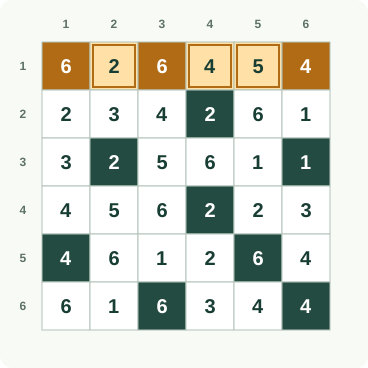
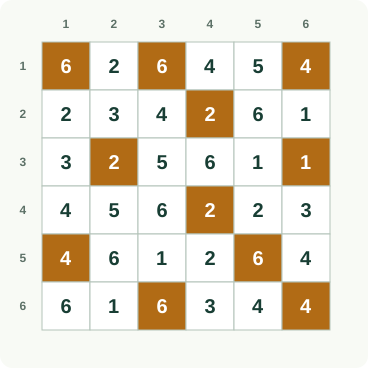
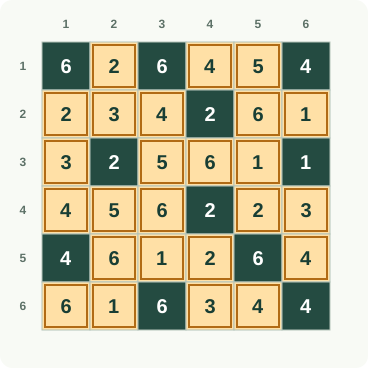
This completed example satisfies every puzzle rule. The individual highlights below identify the cells or edges that demonstrate each rule.
Dark cells are shaded and white cells are retained. Printed numbers are clues, so their appearance alone does not decide a cell’s state. Orange marks highlight new decisions. Tinted squares remain undecided.
Sources and background
Frequently asked questions
Can black Hitori cells touch diagonally?
Yes. Only side contact between black cells is forbidden. Still check the white region: diagonal black arrangements can sometimes block its side-connected routes.
Must one copy of every number remain in a row?
No. The requirement is at most one unshaded copy, not exactly one. All other rules still apply, including non-touching black cells and one connected white region.
Is Hitori a type of Sudoku?
Its printed numbers do not need changing, and rows do not need a complete digit set. You decide which cells to shade while avoiding repeated retained values in rows and columns.
Do diagonally touching whites count as connected?
No. White connectivity uses shared sides only. To travel between retained cells, you must be able to move horizontally or vertically through other white cells.