Nurikabe · EN
How to Play Nurikabe: Rules Explained
To solve Nurikabe, divide the grid into numbered white islands and one connected black sea, giving each island exactly the size shown by its clue. Islands cannot share a side, and the sea cannot contain a solid 2×2 block.
Read each number as an island size
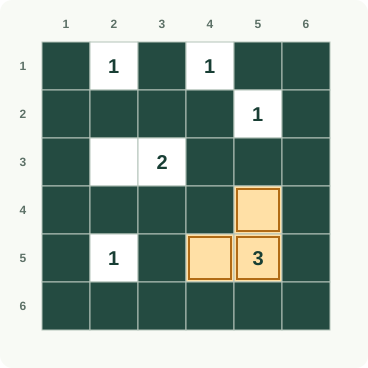
A clue counts the whole island, including the numbered cell itself. An island labelled 1 is already complete; an island labelled 4 needs three additional white cells. The clue does not count adjacent sea cells or describe a row total. Numbers remain white throughout the solve.
An island is a group of white cells joined through shared sides. Its shape can bend, spread in several directions, or touch the boundary. Count cells rather than the length of its outline. The number fixes the area, while the surrounding clues and sea determine the eventual shape.
Give every island exactly one clue
Every separate white group must contain one numbered cell. Two clues cannot end up in the same island, even when their numbers match. A white group with no clue is also invalid at completion: it has no number to specify its size.
Different islands may touch at corners because a corner does not join their cells. Side contact would merge them and break the one-clue rule. This distinction matters especially when two numbered cells sit diagonally apart: the cells between them must prevent a side-connected route from joining their islands.
Keep all black cells connected
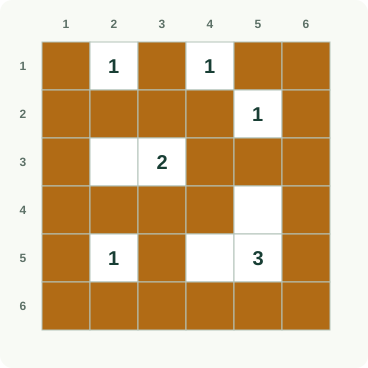
The sea is one group joined through shared sides. Black squares touching only at a corner belong to separate components unless another side-connected route joins them elsewhere. You should be able to travel between any two sea cells using only horizontal or vertical steps through black cells.
The sea can branch and bend; it does not have to form a single unbranched path. There is no rule demanding that every sea cell touch the outside border. What matters is the connection of all black cells across the board, including pockets near corners or between completed islands.
Prevent every solid 2×2 sea square
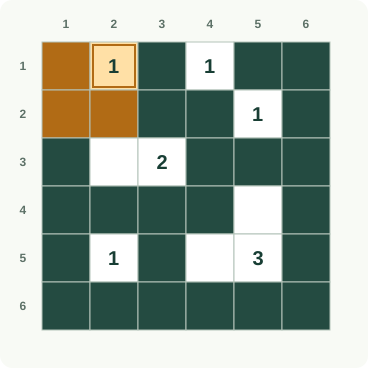
Inspect each group of four cells forming a square. All four cannot be black. Three black cells in such a square force its fourth cell to be white, although you must still work out which numbered island can reach that white cell.
This is a local rule, so checking the sea as one connected region is insufficient. A large black area may be connected perfectly and still fail because it contains one forbidden square. Conversely, a narrow two-cell-wide strip is allowed only if it never contains all four cells of a 2×2 square.
Use completed islands as firm boundaries
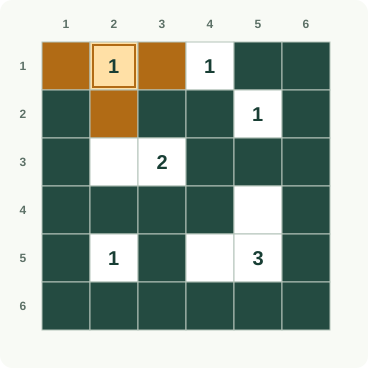
Once an island reaches its clue size, every undecided cell touching its sides must be sea. Otherwise the island would grow too large. Apply this perimeter rule to an island labelled 1 immediately; it has no room to expand in any direction.
Do not surround a partly built island merely because its current shape looks convincing. Until its required number of cells is reached, it may need an open side for growth. A white extension is confirmed only when other choices fail a size, separation, or connectivity requirement.
Avoid the most common rule mistakes
Treat an unmarked square as undecided rather than automatically white. Early in a solve, confirmed island cells, confirmed sea cells, and unknown cells carry different information. Forgetting that difference can make a sea connection appear blocked when an unknown square is still available.
Do not impose symmetry, rectangular islands, or matching shapes for equal clues. None is required. A finished-looking pattern is no substitute for counting each island and checking the black network. The same numerical clue can produce quite different shapes depending on its neighbours.
Names, origin, and your next puzzle
Nurikabe appears in Japanese publisher Nikoli's puzzle catalogue, whose official rule page is the primary reference linked below. English puzzle collections generally retain the name Nurikabe. It is a shading and connectivity puzzle; the name Unequal belongs to Futoshiki and does not describe Nurikabe.
Play Nurikabe free to apply these checks. Continue with the beginner guide for a structured solving order or the strategies guide for reachability and connection deductions. Hitori offers another connected-white-area challenge, while Slitherlink and Hashi develop related connection reasoning with lines and bridges.
A solved example: check every rule
This completed example satisfies every puzzle rule. The individual highlights below identify the cells or edges that demonstrate each rule.
Dark green is sea; white cells are islands. Orange marks identify the current deductions. Each clue counts its own island cell. Tinted squares remain undecided.
Sources and background
Frequently asked questions
Does a Nurikabe number include its own cell?
Yes. A clue of 3 describes an island containing three cells altogether: the numbered cell and two others. Counting three additional cells would make the island too large.
Can Nurikabe islands touch diagonally?
Yes. Different islands may share a corner, but they cannot share a side. White and black connectivity both use side-to-side steps, so a diagonal touch alone never joins two cells into one region.
Must the sea form a loop?
No. It must be one connected group and contain no solid 2×2 block. Branches and dead ends are permitted when all island rules also hold.
Can a white island have no number?
Not in the completed solution. Every white component must contain exactly one clue and match its size. During a solve, an unnumbered white cell still needs a possible connection to its eventual clue.