Hashi · EN
How to Play Hashi: Rules Explained
To solve Hashi, connect numbered islands with horizontal or vertical bridges so each island receives exactly its printed total. Use at most two bridges between a pair of islands, avoid crossings, and connect every island into one network.
Read an island's number as its bridge total
The number counts individual bridges touching that island. A double connection contributes two, and a single connection contributes one. The same bridge contributes to the total at both of its endpoints, so every change needs a check at the island you leave and the island you reach.
A clue does not say how many different neighbours an island must have. An island labelled 4 could receive two double connections or another permitted combination totalling four. Which distribution works depends on the available neighbours, their remaining requirements, crossings, and the need for one connected network.
Find the nearest island in each direction
A bridge runs in a straight horizontal or vertical line between two islands. You cannot draw diagonally, turn midway, or stop in empty space. In a direction containing several islands, only the nearest one is directly reachable because a bridge cannot pass through an intervening island.
Before drawing, scan up, down, left, and right from the chosen island. A nearby island on a diagonal is not a neighbour for bridge purposes. Distance itself does not affect a bridge's value: a long bridge still counts as one, just like a short one.
Choose zero, one, or two bridges
Each visible pair can have no bridge, one bridge, or two parallel bridges. Three bridges between the same pair are never allowed. When a direction has reached two bridges, it has no additional capacity even if one endpoint still needs more bridges elsewhere.
Think of the double line as two bridges along one route, rather than two different routes. It satisfies more of each endpoint's total but offers the same connection between the same two islands. Network connectivity depends on whether a route exists, while the numbers depend on its bridge count.
Keep routes from crossing or passing through islands
A horizontal bridge and a vertical bridge cannot cross in empty space. Once one route is used, any crossing route is excluded completely. This exclusion applies to both single and double bridges; drawing only one line does not leave room for a perpendicular bridge to cross it.
Bridges can meet at an island, where they are supposed to connect. They cannot use that island as an invisible pass-through point: a route reaching it ends there, and a route leaving it is a separate connection that contributes separately to that island's total.
Connect every island into one network
Imagine walking from island to island along the bridges. Every island must be reachable from every other island. Correct numerical totals alone are insufficient: two fully satisfied groups separated from one another make an invalid solution even if every individual number looks right.
Cycles are allowed. Hashi does not require a tree or forbid a ring of bridges. The important global check is that all islands join the same network. A pair of islands that satisfies itself but leaves the rest unreachable is therefore a problem; a connected cycle is not.
Understand capacity before making an early move
An island can receive at most two bridges from each available neighbour, and sometimes fewer because that neighbour has little capacity remaining. If an island needs more bridges than all its other directions can supply together, some bridges in the remaining direction are forced.
For example, the arithmetic behind a 3 with two usable directions is that one direction alone can supply at most two. Therefore both directions must be used at least once. This is a general counting deduction, not permission to ignore an endpoint's total or a crossing route.
Names, source, and further practice
Hashi is commonly called Hashiwokakero or Bridges. Nikoli publishes it under Hashiwokakero and provides the primary rule reference linked below. These names describe the same bridge-building puzzle family; they do not introduce different rules about crossing, totals, or overall connection.
Play Hashi free to practise the basic counts, then use the beginner guide for a solving order or the strategy guide for remaining-capacity and network deductions. Nurikabe develops connected-area reasoning, Slitherlink builds a single loop, and Masyu combines a loop with local turning rules.
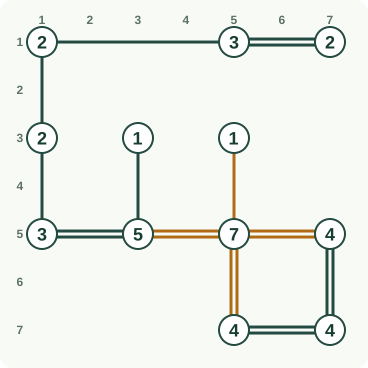
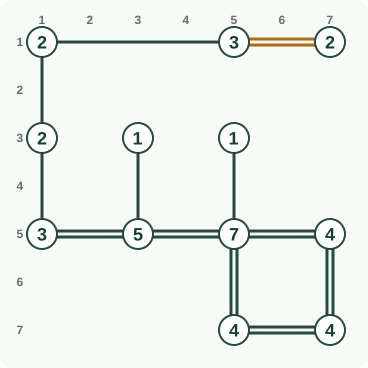
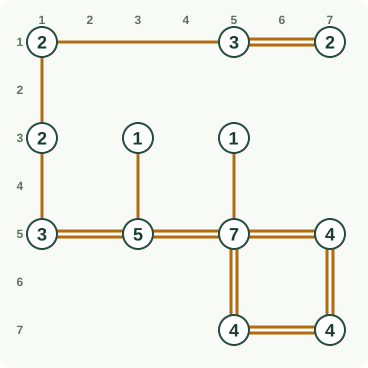
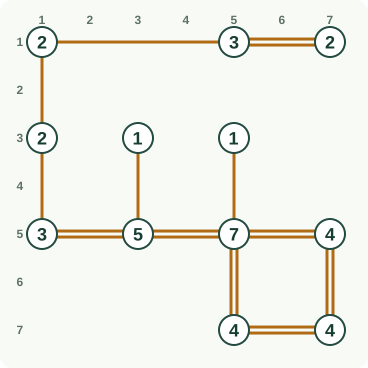
A solved example: check every rule
This completed example satisfies every puzzle rule. The individual highlights below identify the cells or edges that demonstrate each rule.
A double stroke means two bridges. Orange lines or crosses show the current decisions. Rows and columns identify island positions.
Sources and background
Frequently asked questions
Does a double bridge count as one or two?
It counts as two bridges at each endpoint. It is one route between two islands, but both parallel lines contribute to the numbers.
Can Hashi bridges cross?
No. A horizontal and vertical route cannot cross in empty space. Routes may meet at an island, and each such route contributes to that island's total.
Can I connect past a nearer island?
No. A bridge ends at the first island in its direction. To travel beyond it, the network needs another bridge leaving that island, with its own contribution to the total.
Is a ring of bridges allowed?
Yes. Cycles are legal provided all island totals are correct, no bridges cross, and every island belongs to the same connected network. Separate satisfied groups are not allowed.