Masyu · EN
How to Play Masyu: Rules Explained
To solve Masyu, draw one continuous loop through every pearl, travelling horizontally and vertically between neighbouring positions. Turn at black pearls with a straight segment immediately on both sides, and pass straight through white pearls with a turn immediately before or after.
Draw one loop through every pearl
The loop connects neighbouring positions in horizontal or vertical steps. It must return to its starting point without branching, crossing itself, or revisiting a position. Every black and white pearl belongs to this same loop; you cannot satisfy different clusters with separate small loops.
Unmarked positions may be used, but they do not all have to be visited. A loop can pass straight or turn at an ordinary position unless a nearby pearl imposes an extra restriction. Focus first on the pearls, then use the available empty positions to connect their required segments.
Pass straight through a white pearl
At a white pearl the two incident loop segments must lie on opposite sides. The loop therefore passes horizontally or vertically through its centre. It cannot turn on the pearl itself. A white pearl is a straight-through requirement, even when the nearby route bends several times.
There is a second condition: the loop must turn at one or both immediately neighbouring positions along that straight passage. A turn farther away does not count. Once you know the passage is horizontal, inspect the positions directly left and right; for a vertical passage, inspect above and below.
Turn at a black pearl and extend both arms
A black pearl requires a right-angle turn at its centre. The loop then continues straight through the immediately neighbouring position along each arm. In practical terms, each arm extends two grid steps away from the pearl before it is allowed to turn again.
Checking only the turn on the black pearl misses half the rule. If one arm turns again after a single step, the black pearl fails even when the rest of the loop is connected. When drawing a black turn, inspect the full two-step extension in both chosen directions.
Know what degree two means
Every position used by the finished loop has exactly two incident segments. One segment leaves an open end; three create a branch; four create a crossing. An unused ordinary position has zero. These degree counts are a quick way to check a local drawing independently of pearl colour.
Once a position has two confirmed segments, every other incident edge there is excluded. At a pearl, those two must also have the right arrangement and neighbouring behaviour. Satisfying the degree count is necessary but does not by itself prove a pearl correct.
Use the boundary as a restriction
A white pearl on the outside edge must run parallel to that edge, because a perpendicular straight passage would leave the board. Its neighbouring-turn requirement still applies. A black pearl cannot choose an arm that lacks room for its required two-step straight extension.
Near corners, measure each black arm carefully. A direction can offer one adjacent position and still be too short. Boundary restrictions often give the first forced segments, but they follow from the normal pearl rules rather than from a separate rule requiring the loop to follow the perimeter.
Avoid familiar-looking but invalid loops
Do not close a small loop while another pearl or confirmed segment remains outside it. Once closed, a loop cannot be extended without changing its edges. A valid final shape must include all pearls together, even when each separate local group already obeys its colour rules.
Do not swap the pearl meanings: white is straight at the pearl and turns nearby; black turns at the pearl and stays straight nearby. The requirements apply along the actual loop, so an unused perpendicular position next to a white pearl does not satisfy its nearby-turn condition.
Audit the solved diagram pearl by pearl
Trace the solution with one finger or cursor. At each black pearl, identify its turn and the next straight position on both sides. At each white pearl, identify the straight passage and at least one immediate neighbouring turn. This checks the specific geometric rule rather than relying on appearance.
Then trace the whole route from the start until it returns. Confirm that every pearl was encountered once and that no separate loop remains. Ordinary positions outside the route can stay unused. This final audit catches errors that individual pearl checks cannot see.
Name, source, and next steps
Nikoli publishes Masyu under that name and supplies the primary rules linked below. English collections also describe it as a pearl-loop puzzle because the two pearl colours determine the route's behaviour. Masyu is distinct from Futoshiki, whose inequality puzzle is also called Unequal.
Play Masyu free to practise the colour rules. Continue with the beginner guide for a reliable opening scan or the strategy guide for forced orientations and loop continuity. Slitherlink offers another single-loop puzzle, while Hashi and Nurikabe develop related global connection checks.
A solved example: check every rule
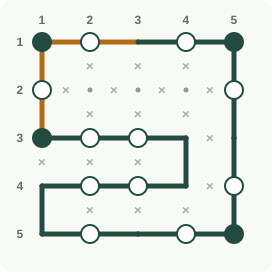
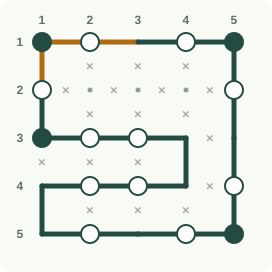
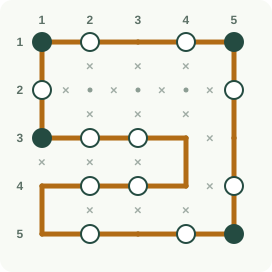
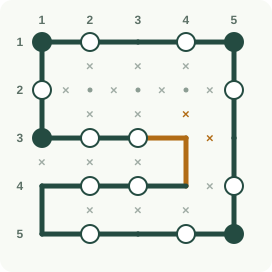
This completed example satisfies every puzzle rule. The individual highlights below identify the cells or edges that demonstrate each rule.
Filled pearls are black and hollow pearls are white. Orange lines and crosses show newly decided loop edges between the numbered points.
Sources and background
Frequently asked questions
Can a white pearl have turns on both sides?
Yes. It requires a turn at at least one immediately neighbouring position along its straight passage. Turning at both neighbours is permitted when the rest of the loop remains valid.
How far must the loop go straight after a black pearl?
It must pass straight through the immediately neighbouring position on each arm. Each arm therefore extends two grid steps from the black pearl before another turn is possible.
Must the Masyu loop visit every position?
No. It must visit every pearl. Ordinary positions can be used or left outside the loop, provided the route forms one unbranched loop and follows all pearl rules.
Can the loop touch or cross itself?
It cannot reuse a position, branch, or cross itself. Nearby segments may occupy different neighbouring positions, but each used position has exactly two incident loop segments.