Slitherlink · EN
How to Play Slitherlink: Rules Explained
To solve Slitherlink, connect neighbouring dots with horizontal and vertical lines to form one unbroken loop. Each numbered cell must have exactly that many loop edges around its four sides, and the loop cannot branch or cross itself.
Count the four sides of each numbered cell
A clue describes the top, right, bottom, and left edges immediately surrounding its cell. A 0 uses none, a 1 uses exactly one, a 2 exactly two, and a 3 exactly three. The number does not count neighbouring cells or lines farther away.
An edge shared by two cells contributes to both of their clue counts if present. This is why checking only one clue at a time is insufficient. A line that completes a 2 may also supply the third required side of an adjacent 3 or wrongly touch a 0.
Treat a blank cell as unrestricted
An empty cell has no numerical requirement. Its surrounding edges are determined by the neighbouring clues and the route of the loop. A blank is not an invisible 0, and the loop may pass beside it just as it passes beside a numbered cell.
The absence of a clue can make local decisions less direct, but the global rules still apply. Edges around a blank cannot create a branch, leave an open endpoint at completion, or form an extra separate loop. Unnumbered space remains part of the connection problem.
Use only segments between adjacent dots
A line follows one grid edge between neighbouring dots. It cannot run diagonally, skip a dot, or travel through the centre of a cell. Longer straight stretches consist of several consecutive grid edges, each counted separately by the clues alongside it.
The route runs around cells rather than through their centres. This distinguishes Slitherlink from pearl puzzles such as Masyu. You decide which cell borders belong to the loop, then use the dots as junction checks to keep those selected borders continuous.
Give every used dot exactly two edges
At a dot on the loop, exactly two incident edges are present. They may be opposite, creating a straight passage, or adjacent, creating a turn. A dot with one line is an unfinished endpoint; three make a branch; four make a crossing.
Dots outside the loop may have no lines at all. You do not need to visit every dot. At an ordinary interior dot, the final count is therefore zero or two, never one, three, or four. Boundary dots obey the same rule despite having fewer available directions.
Make one loop, not several
All selected edges must belong to a single closed route. Several small loops can satisfy many local numbers while still breaking the puzzle. Before connecting two ends of the same open path, check whether closing it would leave another required clue or confirmed edge outside that loop.
The final loop encloses an inside region, but a cell's clue does not say whether that cell is inside or outside. A 3 can appear on either side of the loop depending on the surrounding geometry. Solve its border count rather than assigning it a side by its number.
Keep present, absent, and undecided edges distinct
A confirmed line belongs to the loop. A confirmed excluded edge cannot be used. An undecided edge may still go either way. Remembering exclusions is as important as drawing lines because a dot with one line may be forced to continue through its only remaining option.
A clue already surrounded by its required number of lines excludes all other sides. Conversely, when the remaining available sides exactly equal the number it still needs, all those sides are forced. These are counting consequences of the rule and help you avoid unsupported visual choices.
Audit the solved example in independent passes
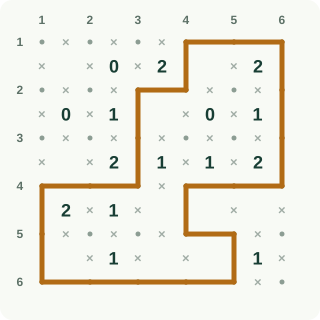
First count the selected sides around every number. Next inspect each dot for zero or two lines. Finally trace the route from one edge until it returns to the start, checking that every selected edge was included. Each pass can reveal a different kind of error.
A complete-looking drawing is not enough. It can have perfect counts but a separate loop, or one continuous route with a wrong clue total. If something fails, identify the specific count, dot, or connection instead of changing unrelated lines until the picture seems more attractive.
Names, origin note, and next steps
Nikoli presents Slitherlink as one of its original puzzles and provides the primary rules linked below. English puzzle collections sometimes use the descriptive name Loop the Loop. The essential task remains a single loop governed by counts around cells, regardless of the printed title.
Play Slitherlink free, then use the beginner guide for 0s, corner deductions, and endpoint continuation. The strategy guide develops inside-outside reasoning and longer connection chains. Masyu offers another single-loop challenge, while Hashi and Nurikabe practise different forms of connected structure.
A solved example: check every rule
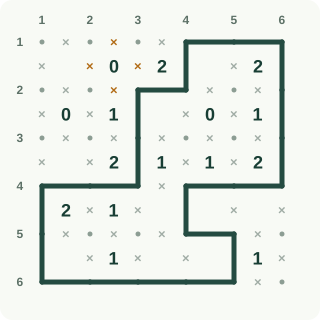
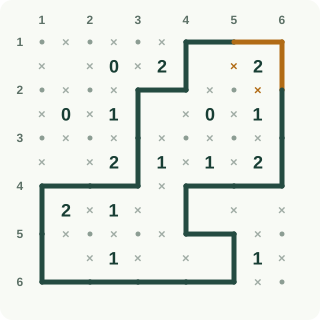
This completed example satisfies every puzzle rule. The individual highlights below identify the cells or edges that demonstrate each rule.
Lines belong to the loop and crosses exclude an edge. Orange marks identify the new decisions; a number counts only its four surrounding edges.
Sources and background
Frequently asked questions
Does a blank Slitherlink cell mean zero?
No. It has no clue count. Its sides may be selected or excluded as needed by neighbouring clues and the single-loop rule.
Must the loop pass through every dot?
No. Used dots have exactly two incident lines; unused dots have none. The loop needs to satisfy all numbered cells, rather than visit every grid point.
Can there be more than one loop?
No. Every selected edge must belong to the same closed route. Separate loops are invalid even if the numbers around them all have correct counts.
Does a 3 have to be inside the loop?
No. The clue counts its surrounding line segments, not its position inside or outside. Check exactly three selected sides and let the full loop determine which side the cell occupies.