Nurikabe · EN
Nurikabe Solving Strategies: Islands, Reachability and Sea Connections
Solve harder Nurikabe puzzles by combining island-size limits with reachability, single-exit growth, and the requirement that every sea cell stays connected. A strong deduction rules out an alternative with a specific constraint, even when the island's final shape is still unknown.
Completed-island bordering and clue separation
Begin each strategy scan with confirmed information. An island at its target size forces sea along every undecided side of its perimeter. Two numbered islands cannot merge, so any cell that would directly join them is sea. Apply these checks to whole white components, not only to clue squares.
These simple deductions remain useful late in a difficult puzzle. A remote sea decision can force the final white cell of a small island; completing that island may then supply several black perimeter cells. Treat a completed island as a new source of deductions rather than merely something to tick off.
Island reachability and distance limits
For an undecided cell, ask which clues could still reach it using only cells that may become land. Confirmed sea, other numbered islands, and exhausted island sizes restrict those routes. If no island can possibly include the cell within its required area, it must be sea.
Use a shortest possible route as a lower bound, not a promise. Even a short route can fail because it touches another island or needs extra connecting cells. When calculating from a partially built island, include its existing area and count only the additional cells required to reach the target.
Single-exit growth and forced connectors
An island that still needs cells must have a way to expand. If only one candidate cell touches its entire current frontier, that square is forced land. The same idea applies to an unnumbered white component: it needs a route to a clue, and a unique connector on all feasible routes must be white.
Check alternatives carefully before declaring an exit unique. The island may be able to grow from a distant end, or an unnumbered white group may reach a different clue. List all live frontier cells and eliminate them by sea, overgrowth, or contact with another clue.
Sea bottlenecks and articulation cells
Trace the confirmed sea components through undecided cells that could still become black. If one undecided square is the only available connector between existing sea groups, it must be sea. Making it land would permanently divide the black network and violate the global connectivity requirement.
A bottleneck is a statement about every remaining route, not just the nearest route. Follow corridors around the outside of islands before deciding that a connector is unique. Once it is proved black, inspect neighbouring 2×2 squares and completed-island frontiers for immediate consequences.
Pool prevention with three black cells
The usual no-pool deduction examines a 2×2 square containing three black cells: the fourth is forced white. On a hard puzzle, its main value can be indirect. The new white cell may have only one possible clue connection, which then fixes an island extension or eliminates a competing island shape.
Do not stop after applying the local colour change. Recalculate the receiving island's remaining size, examine whether the connection is itself forced, and close its border if complete. This is how a small square-level deduction can resolve a larger region without trial and error.
Enumerate a small island's remaining shapes
When an island needs only a few more cells, list its feasible extensions. Reject shapes that cross sea, touch another island, exceed the clue, create an unavoidable black square, or seal off confirmed sea. Cells present in every surviving shape are land; cells outside every possible island's reach are sea.
Keep this enumeration local and complete. Seeing two plausible shapes does not prove they are the only two. Start from every open frontier and include bent extensions as well as straight ones. The goal is a shared consequence of all valid shapes, not selecting a favourite drawing.
Use a contradiction as an explicit proof
If direct scans stall, choose a constrained cell and temporarily assume one colour. Follow only forced consequences. An island with too many cells, an island without enough reachable space, a merged pair of clues, a trapped sea component, or an unavoidable black 2×2 square disproves that assumption.
Record the assumption and the first impossible result so the reasoning can be checked. Undo every dependent mark before confirming the opposite colour. Long unrecorded branches are difficult to audit; a short contradiction near a nearly completed island is usually more informative.
A harder worked example
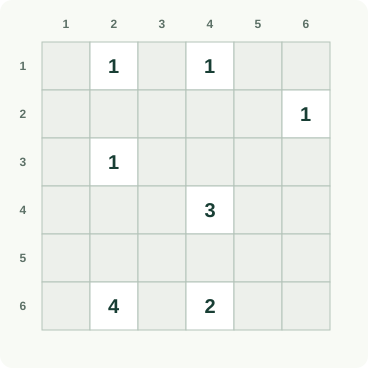
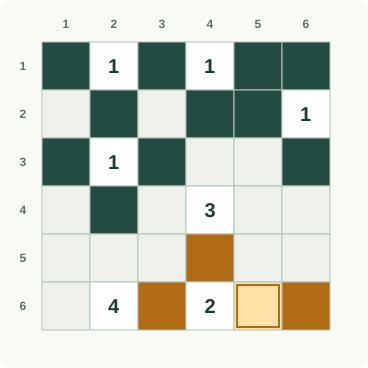
This board uses the Hard preset. Follow the four cumulative stages, revisiting each affected constraint after a deduction. Dark green is sea; white cells are islands. Orange marks identify the current deductions. Each clue counts its own island cell. Tinted squares remain undecided.
Worked stage 1
Surround the completed one-cell islands before growing larger ones. The marked sea cells follow directly from those finished boundaries. This removes misleading routes without committing to any uncertain island shape or treating diagonal contact as a connection.
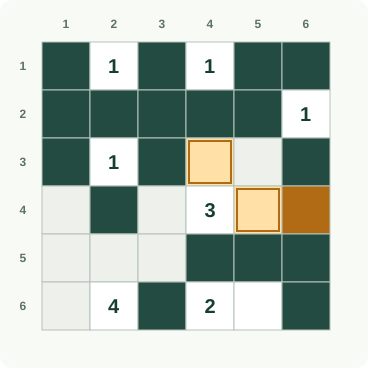
Worked stage 2
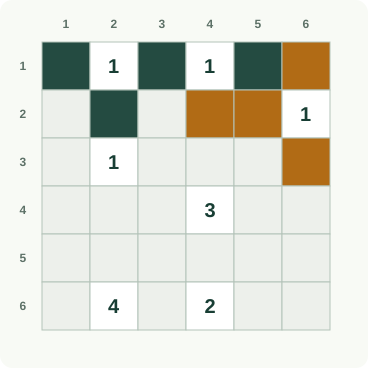
Keep numbered islands separate, then compare every legal two-cell shape from the lower clue. Their shared square is forced land. Surround that completed island with sea, using the visible clue sizes rather than a remembered answer.
Worked stage 3
Exclude cells outside every remaining island’s reach. Where three sea squares occupy a 2×2 block, the fourth must be land. Reapply both deductions until the upper three-cell island reaches its exact size and no longer grows.
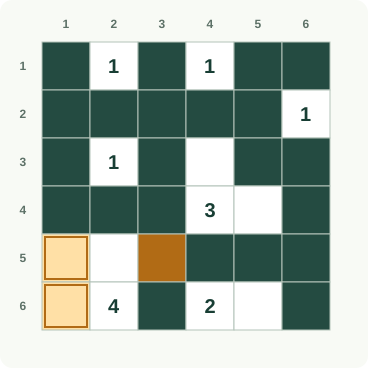
Worked stage 4
Test the remaining alternatives explicitly. One choice disconnects the sea; another makes established land unreachable from its clue. Reject those assumptions, keep the surviving island extensions, then verify connected sea and the absence of a 2×2 pool.
Sources and background
Worked example: follow each deduction
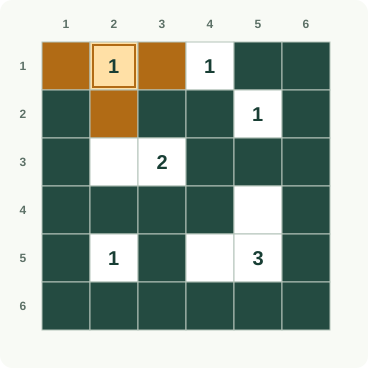
Read rows from top to bottom and columns from left to right, starting at 1. Read each instruction, then compare the orange changes with the previous picture. Keep undecided cells or segments open until the explanation settles them.
■ sea; □ island; ? = undecided
Follow these changes in order; the picture below includes all of them.
Colour row 1, column 1 black for sea. The island at row 1, column 2 has already reached its clue, 1. The numbered square counts toward that area. Another white square would exceed it, so every side neighbour must be black sea.
Colour row 1, column 3 black for sea. The island at row 1, column 2 has already reached its clue, 1. The numbered square counts toward that area. Another white square would exceed it, so every side neighbour must be black sea.
Colour row 2, column 2 black for sea. The island at row 1, column 2 has already reached its clue, 1. The numbered square counts toward that area. Another white square would exceed it, so every side neighbour must be black sea.
Colour row 1, column 5 black for sea. The island at row 1, column 4 has already reached its clue, 1. The numbered square counts toward that area. Another white square would exceed it, so every side neighbour must be black sea.
Colour row 2, column 4 black for sea. The island at row 1, column 4 has already reached its clue, 1. The numbered square counts toward that area. Another white square would exceed it, so every side neighbour must be black sea.
Colour row 2, column 5 black for sea. The island at row 2, column 6 has already reached its clue, 1. The numbered square counts toward that area. Another white square would exceed it, so every side neighbour must be black sea.
Colour row 1, column 6 black for sea. The island at row 2, column 6 has already reached its clue, 1. The numbered square counts toward that area. Another white square would exceed it, so every side neighbour must be black sea.
Colour row 3, column 6 black for sea. The island at row 2, column 6 has already reached its clue, 1. The numbered square counts toward that area. Another white square would exceed it, so every side neighbour must be black sea.
Step 1: the orange outlines mark the changes explained above. Follow these changes in order; the picture below includes all of them.
Colour row 3, column 1 black for sea. The island at row 3, column 2 has already reached its clue, 1. The numbered square counts toward that area. Another white square would exceed it, so every side neighbour must be black sea.
Colour row 3, column 3 black for sea. The island at row 3, column 2 has already reached its clue, 1. The numbered square counts toward that area. Another white square would exceed it, so every side neighbour must be black sea.
Colour row 4, column 2 black for sea. The island at row 3, column 2 has already reached its clue, 1. The numbered square counts toward that area. Another white square would exceed it, so every side neighbour must be black sea.
Colour row 5, column 4 black for sea. Making this square white would join two different numbered islands. Islands cannot share a side, so keep this separating square black.
Colour row 6, column 3 black for sea. Making this square white would join two different numbered islands. Islands cannot share a side, so keep this separating square black.
Keep row 6, column 5 white as part of an island. The island rooted at row 6, column 4 must reach 2 white squares. Every remaining shape that reaches that size without merging islands includes this square, so it must be white.
Colour row 6, column 6 black for sea. The island at row 6, column 4 has already reached its clue, 2. The numbered square counts toward that area. Another white square would exceed it, so every side neighbour must be black sea.
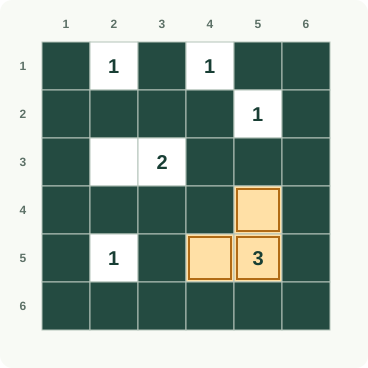
Step 2: the orange outlines mark the changes explained above. Follow these changes in order; the picture below includes all of them.
Colour row 5, column 5 black for sea. The island at row 6, column 4 has already reached its clue, 2. The numbered square counts toward that area. Another white square would exceed it, so every side neighbour must be black sea.
Colour row 2, column 1 black for sea. Every white square must join one numbered island by sides, within that island’s size limit. No remaining legal island can reach this square, so it must be sea.
Colour row 2, column 3 black for sea. Every white square must join one numbered island by sides, within that island’s size limit. No remaining legal island can reach this square, so it must be sea.
Colour row 5, column 6 black for sea. Every white square must join one numbered island by sides, within that island’s size limit. No remaining legal island can reach this square, so it must be sea.
Keep row 3, column 4 white as part of an island. The other three squares of this 2×2 block are sea: row 2, column 3; row 2, column 4; row 3, column 3. Making the fourth sea would create a forbidden solid pool. Keep it white.
Colour row 4, column 6 black for sea. Every white square must join one numbered island by sides, within that island’s size limit. No remaining legal island can reach this square, so it must be sea.
Keep row 4, column 5 white as part of an island. The other three squares of this 2×2 block are sea: row 4, column 6; row 5, column 5; row 5, column 6. Making the fourth sea would create a forbidden solid pool. Keep it white.
Step 3: the orange outlines mark the changes explained above. Follow these changes in order; the picture below includes all of them.
Colour row 3, column 5 black for sea. The island at row 4, column 4 has already reached its clue, 3. The numbered square counts toward that area. Another white square would exceed it, so every side neighbour must be black sea.
Colour row 4, column 3 black for sea. The island at row 4, column 4 has already reached its clue, 3. The numbered square counts toward that area. Another white square would exceed it, so every side neighbour must be black sea.
Colour row 4, column 1 black for sea. This is a trial-and-contradiction step. Temporarily try a white island square here and continue the rules from the current grid. Every continuation fails: an established white square cannot join any numbered island or the black sea splits into groups that cannot connect by sides or the remaining islands leave an unavoidable solid 2×2 sea block. Undo that trial and use the stated choice.
Keep row 5, column 2 white as part of an island. The island rooted at row 6, column 2 must reach 4 white squares. Every remaining shape that reaches that size without merging islands includes this square, so it must be white.
Keep row 5, column 1 white as part of an island. This is a trial-and-contradiction step. Temporarily try a black sea square here and continue the rules from the current grid. Every continuation fails: the black sea splits into groups that cannot connect by sides. Undo that trial and use the stated choice.
Colour row 5, column 3 black for sea. This is a trial-and-contradiction step. Temporarily try a white island square here and continue the rules from the current grid. Every continuation fails: an established white square cannot join any numbered island or the black sea splits into groups that cannot connect by sides. Undo that trial and use the stated choice.
Keep row 6, column 1 white as part of an island. The island rooted at row 6, column 2 must reach 4 white squares. Every remaining shape that reaches that size without merging islands includes this square, so it must be white.
Step 4: the orange outlines mark the changes explained above.
Frequently asked questions
What does unreachable mean in Nurikabe?
A cell is unreachable when no numbered island can include it within the clue's size using any legal land route. It is then sea. Measure against all possible clues and account for existing island cells before making the deduction.
When is a sea connector forced?
When making that cell land would leave confirmed sea groups with no remaining side-connected route between them. Check all possible alternative routes, including around the grid boundary, before treating a narrow passage as mandatory.
Are all advanced Nurikabe techniques guesses?
No. Reachability limits, shared cells among feasible island shapes, and connectivity bottlenecks are direct deductions. A temporary assumption can also become a proof when its forced consequences reach a clear contradiction.
What should I check first when stuck?
Recount completed islands, inspect new three-black 2×2 squares, and trace separate sea components. Then examine small islands with very few feasible shapes. These targeted scans are more useful than repeatedly looking over every undecided cell.