Binary · EN
How to Play Binary: Binairo and Takuzu Rules Explained
To play Binary, fill every cell with 0 or 1 so each row and column has equal numbers of both digits, no three identical digits appear consecutively, and no two rows or two columns are identical. GooferThings uses a 6×6 grid, so each completed line contains three zeros and three ones.
Two symbols, three constraints
The printed zeros and ones are fixed clues. Fill only the remaining cells, treating 0 as a real entry rather than an empty value. Although the symbols are digits, you do not perform binary arithmetic. They could be replaced by two colors without changing the puzzle's logic. What matters is their positions and the relationships between lines.
Every placement affects a horizontal row and a vertical column. A value that is legal horizontally can be illegal vertically, so check both directions. The finished board must satisfy all three constraints together. Balanced rows alone do not guarantee balanced columns, and avoiding triples alone does not guarantee a valid puzzle.
Balance every row and every column
A six-cell line needs three 0s and three 1s. Once a row has three confirmed zeros, its other cells must be ones. Once a column has three confirmed ones, its other cells must be zeros. This quota applies separately to each line, including lines that share some of their cells.
On another even-sized board, divide the line length by two to find the required count. Here the target is always three of each. Do not use the number of zeros on the entire board as a substitute for line checks. The overall totals can look correct while one row has four zeros and another has only two.
Avoid triples in straight lines
No row or column may contain 000 or 111 in consecutive cells. Two equal digits next to one another are allowed, but their immediate neighbors along that line must be the opposite digit wherever those neighbors exist. Two equal digits separated by one blank also force that blank to be the opposite digit.
The rule concerns contiguous runs, not the total number of repeated digits in a line. A row can contain three zeros if they do not make a consecutive triple. Diagonals do not count, and there is no wraparound from one edge to the other. A 2×2 square of equal values is not prohibited by a separate block rule.
Make rows distinct and columns distinct
No two completed rows may have exactly the same sequence from left to right. No two completed columns may have exactly the same sequence from top to bottom. The comparison is position by position; having the same count of zeros is expected and does not make two lines duplicates.
A row is allowed to match a column. Likewise, a reversed or complemented sequence is not automatically forbidden: it is a different sequence unless it matches another line exactly. The uniqueness rule is easy to forget because many early moves come from quotas and triples. Still, every final row pair and column pair must be checked.
Learn the deductions that follow from the rules
Pair extension uses adjacent equal digits to force the opposite digit beside the pair. Gap filling uses equal endpoints to force the opposite digit between them. Quota completion fills a line's remaining blanks once one digit reaches its allowed count. These are deductions from the rules, not extra rules you need to memorize independently.
Line uniqueness usually becomes useful later. If a possible completion would exactly duplicate a completed parallel line, that completion is forbidden. It does not follow that each undecided cell must differ from the other line. Only one difference somewhere is required, so keep the full alternatives until the position of that difference is forced.
Check a completed board without shortcuts
Review all rows for three zeros, three ones and no triple, then repeat the same process for columns. Compare every pair of rows and every pair of columns for exact equality. Finally confirm that all printed clues remain unchanged. A board with every cell filled is a proposal until these checks pass.
If the puzzle becomes inconsistent, look for a move that was justified in only one direction. Another common error is excluding a partial line because it currently resembles another partial line. Unfinished rows may agree so far and still become different later. A uniqueness deduction needs the remaining alternatives to show that a duplicate would actually be unavoidable.
Other names and a cautious origin note
Binary puzzles are also encountered as Takuzu, Binairo or Binero. The World Intellectual Property Organization's 2010 gazette records the name BINAIRO under the Belgian puzzle makers Peter De Schepper and Frank Coussement. That primary record supports the name's association with them without proving that every earlier two-symbol puzzle had the same origin.
A solved example: check every rule
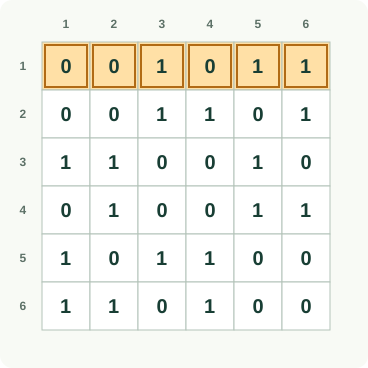
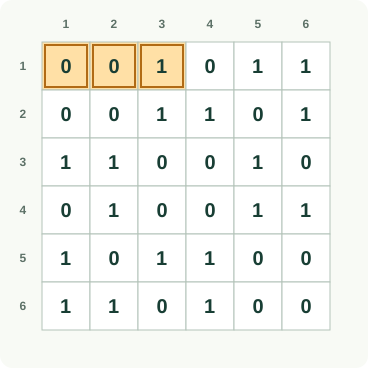
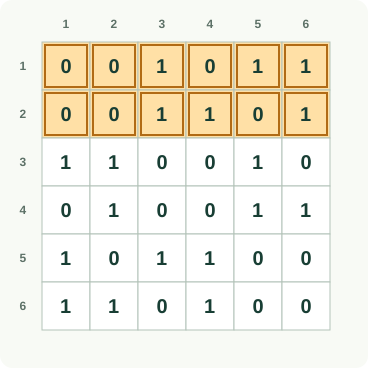
This completed example satisfies every puzzle rule. The individual highlights below identify the cells or edges that demonstrate each rule.
The printed values are 0 and 1. Orange outlines show new values. Blank squares remain undecided, and each six-cell line needs three of each digit. Tinted squares remain undecided.
Sources and background
Frequently asked questions
Are two identical digits next to each other allowed?
Yes. A pair such as 00 or 11 is legal. Three identical consecutive digits in a row or column are forbidden. The cells immediately beyond an equal pair, when present, therefore need the opposite digit.
Can a row be identical to a column in Binary?
Yes. The distinctness rule compares rows with other rows and columns with other columns. A row-column match is allowed. Check the order of all six positions when deciding whether two parallel lines are duplicates.
Is Binary the same as binary arithmetic?
No. The puzzle uses zeros and ones as two symbols. You do not convert numbers or calculate in base two. Solve by balancing line counts, preventing consecutive triples and keeping parallel lines distinct.