Binary · EN
Binary Solving Strategies: From Local Patterns to Line Logic
Harder Binary puzzles are solved by comparing complete legal line patterns as well as individual cells. Use pair and gap deductions first, then combine remaining quotas, crossing constraints and row-column uniqueness to eliminate whole arrangements safely.
Keep the three elementary scans active
Pair extension forces the opposite digit immediately beyond adjacent matching digits. Gap filling forces the opposite digit between equal endpoints one cell apart. Quota completion fills remaining blanks once one digit has reached half the line length. On GooferThings' six-cell lines, that quota is three. These techniques remain useful after every advanced elimination.
A move can be legal in its own row and impossible in its column. Therefore update both crossing lines after every entry rather than finishing a long horizontal scan in isolation. If an advanced technique produces several values, process their local consequences before looking for another elaborate pattern; the simpler effects may already solve the next section.
Quota bounds: test whether enough positions remain
An unfinished line has a remaining demand for zeros and ones. Compare that demand with the cells still capable of taking each digit. If a line needs two more zeros and exactly two blanks can be zero, both are forced. This is a generalized quota argument: it still works when other blanks remain because those blanks are already restricted to one.
The restrictions can come from perpendicular triples or quotas, so a line may gain information even before any new entry appears within it. Keep candidate symbols accurate. If a line needs more zeros than it has possible zero positions, you have found a contradiction in the current entries or notes, not a new relaxation of the balance rule.
Line-pattern filtering: reason with complete alternatives
For a difficult row, consider every six-digit sequence that has three zeros, three ones, no triple and all its fixed entries. Discard a sequence if it conflicts with a crossing column's current constraints. A blank is forced when every remaining row sequence gives it the same value, even if no isolated pair or gap reveals that value directly.
Apply the same method to columns. After a value is forced, refilter the crossing patterns and repeat until nothing changes. This approach is particularly useful when a line has few blanks but their effects are separated. You do not need to list the entire board's possibilities; begin with one restrictive line and preserve its complete alternatives.
Duplicate avoidance: reject sequences, then derive cells
A completed row forbids that exact row sequence elsewhere. Remove it from every other row's legal pattern list. Do the corresponding operation with completed columns. Only after filtering should you inspect whether all surviving patterns agree on a cell. This avoids the mistake of requiring every undecided position to differ from the reference line.
With two blanks, balance may permit just two arrangements. If one would duplicate a completed parallel line, the other becomes forced. With more blanks, rejecting one duplicate may leave several arrangements and no immediate entry. That is still progress: keep the smaller pattern set and let crossing constraints distinguish its remaining alternatives.
Pattern pairs: reserve sequences across parallel lines
The uniqueness condition also applies to unfinished lines. If two rows each have only the same two legal full-row sequences, they must use those sequences in opposite assignments. No other row may use either sequence. This is a pair of complete patterns, not merely two cells containing both symbols. Its consequence is a restriction on other rows' pattern lists.
Use the same reasoning for columns. Verify that the two rows genuinely have no third sequence before applying it. The method does not necessarily decide which sequence belongs to which row. Crossing constraints may settle their order later, or they may force useful values elsewhere after the reserved sequences are removed.
Controlled contradiction: name the rule that fails
If direct filtering stalls, temporarily test one value in a constrained cell. Propagate pairs, gaps, quotas and exact duplicate exclusions. A resulting triple, an exceeded quota, an impossible remaining quota or two unavoidable identical parallel lines disproves the tested value. Restore the temporary chain, then enter the opposite digit only if the contradiction was sound.
Do not treat an unattractive arrangement as a contradiction. Binary grids can contain adjacent pairs, matching diagonals and rows that resemble one another strongly. Only the actual rules eliminate an alternative. Keep the chain short and record the decisive failure so you can audit it if later consequences become inconsistent.
A harder worked example
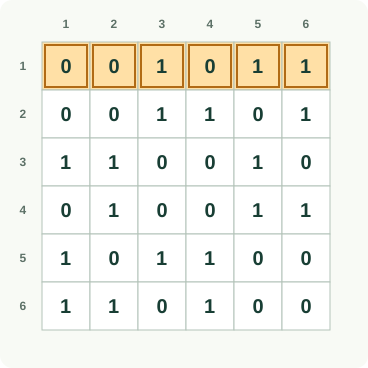
This board uses the Hard preset. Follow the four cumulative stages, revisiting each affected constraint after a deduction. The printed values are 0 and 1. Orange outlines show new values. Blank squares remain undecided, and each six-cell line needs three of each digit. Tinted squares remain undecided.
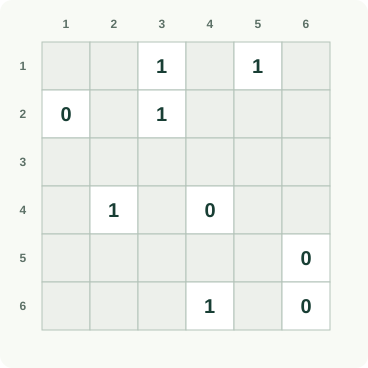
Worked stage 1
Start with balanced, triple-free possibilities for the first row and crossing columns. Place a digit only when every remaining possibility agrees. Those forced digits settle the first row and provide the next useful counts in the left column.
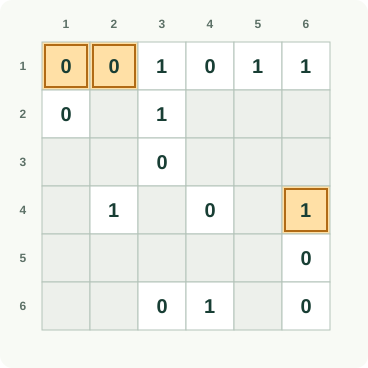
Worked stage 2
Propagate the first-column counts, then test the unresolved second-row alternative. Every continuation of the rejected choice duplicates a completed line. Keep the other digit and use the second column’s balanced possibilities to obtain the next forced values.
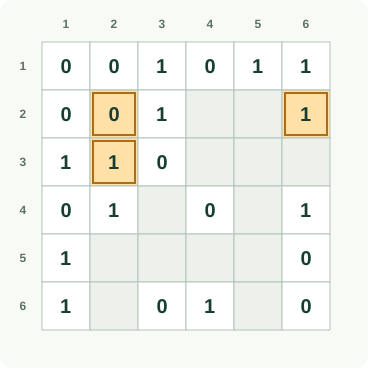
Worked stage 3
Use line balance where possible, then test the unresolved middle cells against line uniqueness. The rejected assumptions force duplicated rows or columns. Record the surviving digits only after those contradictions, then propagate the three-of-each counts again.
Worked stage 4
Finish the last middle-column alternative using the same uniqueness check. Its surviving value settles the remaining rows through balance and triple avoidance. Compare every pair of completed rows and every pair of completed columns before accepting the final grid.
Sources and background
Worked example: follow each deduction
Read rows from top to bottom and columns from left to right, starting at 1. Read each instruction, then compare the orange changes with the previous picture. Keep undecided cells or segments open until the explanation settles them.
0 and 1 are digits; ? = undecided
Follow these changes in order; the picture below includes all of them.
Write 0 at row 1, column 4. For row 1, keep only patterns with 3 zeros, 3 ones and no three equal digits together, matching the fixed cells. They are 0 0 1 0 1 1 or 0 1 1 0 1 0 or 1 0 1 0 1 0. This position is 0 in every pattern.
Write 0 at row 3, column 3. For column 3, keep only patterns with 3 zeros, 3 ones and no three equal digits together, matching the fixed cells. They are 1 1 0 0 1 0 or 1 1 0 1 0 0. This position is 0 in every pattern.
Write 0 at row 6, column 3. For column 3, keep only patterns with 3 zeros, 3 ones and no three equal digits together, matching the fixed cells. They are 1 1 0 0 1 0 or 1 1 0 1 0 0. This position is 0 in every pattern.
Write 1 at row 1, column 6. For column 6, keep only patterns with 3 zeros, 3 ones and no three equal digits together, matching the fixed cells. They are 1 0 1 1 0 0 or 1 1 0 1 0 0. This position is 1 in every pattern.
Write 1 at row 4, column 6. For column 6, keep only patterns with 3 zeros, 3 ones and no three equal digits together, matching the fixed cells. They are 1 0 1 1 0 0 or 1 1 0 1 0 0. This position is 1 in every pattern.
Write 0 at row 1, column 1. For row 1, keep only patterns with 3 zeros, 3 ones and no three equal digits together, matching the fixed cells. They are 0 0 1 0 1 1. This position is 0 in every pattern.
Write 0 at row 1, column 2. For row 1, keep only patterns with 3 zeros, 3 ones and no three equal digits together, matching the fixed cells. They are 0 0 1 0 1 1. This position is 0 in every pattern.
Step 1: the orange outlines mark the changes explained above. Follow these changes in order; the picture below includes all of them.
Write 1 at row 3, column 1. For column 1, keep only patterns with 3 zeros, 3 ones and no three equal digits together, matching the fixed cells. They are 0 0 1 0 1 1 or 0 0 1 1 0 1. This position is 1 in every pattern.
Write 1 at row 6, column 1. For column 1, keep only patterns with 3 zeros, 3 ones and no three equal digits together, matching the fixed cells. They are 0 0 1 0 1 1 or 0 0 1 1 0 1. This position is 1 in every pattern.
Write 0 at row 4, column 1. For row 4, keep only patterns with 3 zeros, 3 ones and no three equal digits together, matching the fixed cells. They are 0 1 0 0 1 1 or 0 1 1 0 0 1. This position is 0 in every pattern.
Write 1 at row 5, column 1. For column 1, keep only patterns with 3 zeros, 3 ones and no three equal digits together, matching the fixed cells. They are 0 0 1 0 1 1. This position is 1 in every pattern.
Write 0 at row 2, column 2. This is a trial-and-contradiction step. Temporarily try 1 here and continue the rules from the current grid. Every continuation fails: two complete rows or two complete columns become identical. Undo that trial and use the stated choice.
Write 1 at row 2, column 6. For row 2, keep only patterns with 3 zeros, 3 ones and no three equal digits together, matching the fixed cells. They are 0 0 1 0 1 1 or 0 0 1 1 0 1. This position is 1 in every pattern.
Write 1 at row 3, column 2. For column 2, keep only patterns with 3 zeros, 3 ones and no three equal digits together, matching the fixed cells. They are 0 0 1 1 0 1. This position is 1 in every pattern.
Step 2: the orange outlines mark the changes explained above. Follow these changes in order; the picture below includes all of them.
Write 0 at row 5, column 2. For column 2, keep only patterns with 3 zeros, 3 ones and no three equal digits together, matching the fixed cells. They are 0 0 1 1 0 1. This position is 0 in every pattern.
Write 1 at row 6, column 2. For column 2, keep only patterns with 3 zeros, 3 ones and no three equal digits together, matching the fixed cells. They are 0 0 1 1 0 1. This position is 1 in every pattern.
Write 0 at row 3, column 6. For row 3, keep only patterns with 3 zeros, 3 ones and no three equal digits together, matching the fixed cells. They are 1 1 0 0 1 0 or 1 1 0 1 0 0. This position is 0 in every pattern.
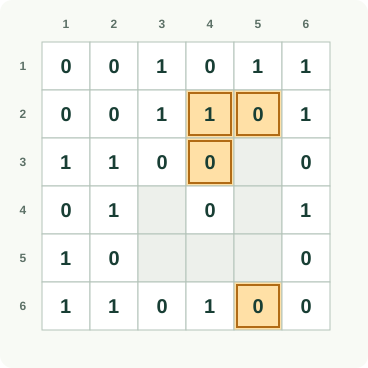
Write 0 at row 6, column 5. For row 6, keep only patterns with 3 zeros, 3 ones and no three equal digits together, matching the fixed cells. They are 1 1 0 1 0 0. This position is 0 in every pattern.
Write 1 at row 2, column 4. This is a trial-and-contradiction step. Temporarily try 0 here and continue the rules from the current grid. Every continuation fails: two complete rows or two complete columns become identical. Undo that trial and use the stated choice.
Write 0 at row 2, column 5. For row 2, keep only patterns with 3 zeros, 3 ones and no three equal digits together, matching the fixed cells. They are 0 0 1 1 0 1. This position is 0 in every pattern.
Write 0 at row 3, column 4. This is a trial-and-contradiction step. Temporarily try 1 here and continue the rules from the current grid. Every continuation fails: two complete rows or two complete columns become identical. Undo that trial and use the stated choice.
Step 3: the orange outlines mark the changes explained above. Follow these changes in order; the picture below includes all of them.
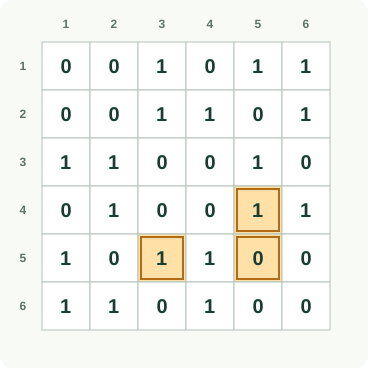
Write 1 at row 3, column 5. For row 3, keep only patterns with 3 zeros, 3 ones and no three equal digits together, matching the fixed cells. They are 1 1 0 0 1 0. This position is 1 in every pattern.
Write 1 at row 5, column 4. For column 4, keep only patterns with 3 zeros, 3 ones and no three equal digits together, matching the fixed cells. They are 0 1 0 0 1 1. This position is 1 in every pattern.
Write 0 at row 4, column 3. This is a trial-and-contradiction step. Temporarily try 1 here and continue the rules from the current grid. Every continuation fails: two complete rows or two complete columns become identical. Undo that trial and use the stated choice.
Write 1 at row 5, column 3. For column 3, keep only patterns with 3 zeros, 3 ones and no three equal digits together, matching the fixed cells. They are 1 1 0 0 1 0. This position is 1 in every pattern.
Write 1 at row 4, column 5. For row 4, keep only patterns with 3 zeros, 3 ones and no three equal digits together, matching the fixed cells. They are 0 1 0 0 1 1. This position is 1 in every pattern.
Write 0 at row 5, column 5. For row 5, keep only patterns with 3 zeros, 3 ones and no three equal digits together, matching the fixed cells. They are 1 0 1 1 0 0. This position is 0 in every pattern.
Step 4: the orange outlines mark the changes explained above.
Frequently asked questions
How do I use uniqueness without guessing?
Reject any complete line pattern that exactly matches a completed parallel line. Then inspect what all remaining patterns have in common. Similar partial lines are allowed, and a line needs only one difference somewhere, not a difference in every cell.
What is a legal line pattern?
It is a complete sequence that respects the fixed entries, equal symbol counts and no-triples rule. Crossing-line restrictions and the uniqueness rule can remove additional patterns. A cell is forced when every surviving pattern assigns the same symbol there.
Are diagonals useful in Binary?
They can draw your eye to nearby cells, but there is no diagonal rule here. A deduction must ultimately use horizontal or vertical triples, line quotas or distinct parallel lines. Do not eliminate a value solely because of matching diagonal symbols.