Binary · EN
Binary for Beginners: Solve with Pairs, Gaps and Counts
Begin a Binary puzzle by extending equal pairs, filling gaps between equal digits and completing any row or column that has reached its zero or one quota. After each entry, inspect both crossing lines before moving on to uniqueness comparisons.
Count the target before making a move
On GooferThings, every row and column has six cells and must finish with three zeros and three ones. Note how many of each are already confirmed in a promising line. Do not count blank cells as zeros. The printed 0 is a real clue, and a blank can still become either digit.
A useful first scan looks for adjacent equal pairs and equal digits with one empty cell between them. Those patterns supply direct deductions without comparing whole lines. Look horizontally and vertically. It is easy to solve several rows while missing a simple pair in a column that would unlock the next part of the puzzle.
First deduction: extend an equal pair with the opposite digit
When two adjacent cells contain the same digit, a neighboring cell immediately beyond either end cannot repeat it: that would make a forbidden triple. Fill the opposite digit at each such end that exists. A pair at an edge has only one outward neighbor on the board; there is no imaginary cell beyond the boundary.
This pair-extension technique is local. It does not force every remaining cell in the line to be opposite, because the line may still need more copies of the paired digit elsewhere. After filling an end, inspect the crossing column or row. The new value may complete a different pair there and start a chain of deductions.
Second deduction: fill a gap between matching digits
If two equal digits have exactly one blank between them, that blank must contain the opposite digit. Otherwise the three consecutive cells would all match. This gap-filling pattern works in either orientation and for either digit. Check that the endpoints are exactly two positions apart; a wider gap does not produce the same immediate conclusion.
Matching endpoints do not ban the same digit from every cell between them in a larger space. You need the precise three-cell window. Read each small pattern independently, then check the line quota before entering a value. If the forced digit appears to exceed the quota, trace an earlier entry instead of making an exception to the triple rule.
Third deduction: complete the line quota
Once a six-cell row contains three zeros, all its remaining blanks must be ones. A row containing three ones finishes with zeros. Repeat the same check for columns. Quota completion can fill blanks far apart, unlike pair and gap patterns, so update every crossing line affected by a batch of entries.
Before filling several cells, count the confirmed symbols carefully. Two written possibilities are not two confirmed entries. After completing the line, check that it contains no consecutive triple. The quota and no-triples rules are equally mandatory; if they disagree, the existing line already contains an error that needs correction.
Fourth deduction: compare possible completions
When the basic patterns stop, list the ways an unfinished line could be completed while preserving balance and avoiding triples. A short list is more useful than choosing the arrangement that looks most evenly distributed. Compare each possible completion with the crossing lines, which may rule out a value even when it is locally legal.
Also compare a possible row with every completed row, or a possible column with every completed column. An exact duplicate is forbidden. This does not require every cell to differ. If several legal, distinct completions remain, preserve them until another constraint decides. Similar-looking partial lines are not automatically a contradiction.
Start with this easy puzzle
The printed values are 0 and 1. Orange outlines show new values. Blank squares remain undecided, and each six-cell line needs three of each digit. Tinted squares remain undecided.
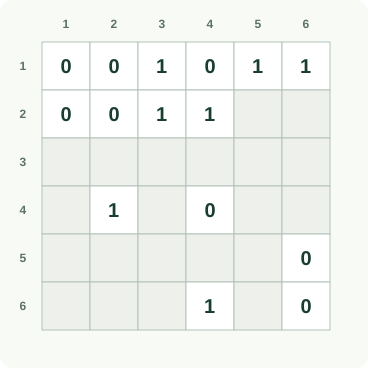
Step 1: Keep balanced triple-free patterns
List only balanced, triple-free possibilities for each affected line. Agreement between those possibilities forces the two first-column digits and the highlighted second-row zero. Write R3C1=1, R6C1=1, R2C5=0.
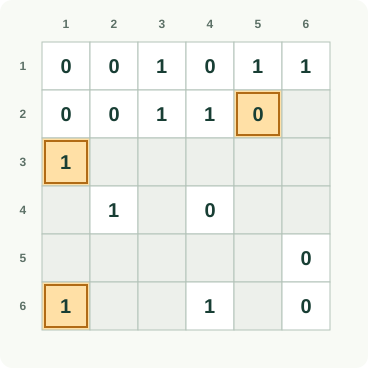
Step 2: Propagate the second-row crossings
Finish the forced second-row digit, then compare the second column’s balanced possibilities. Existing neighbors and its required three-of-each count fix both highlighted cells. Write R2C6=1, R3C2=1, R5C2=0.
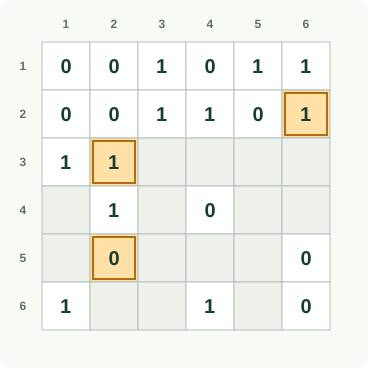
Step 3: Complete the next forced pair
The second column’s remaining possibilities agree on its bottom digit. That placement reduces the third row enough to determine its next zero. Write R6C2=1, R3C3=0.
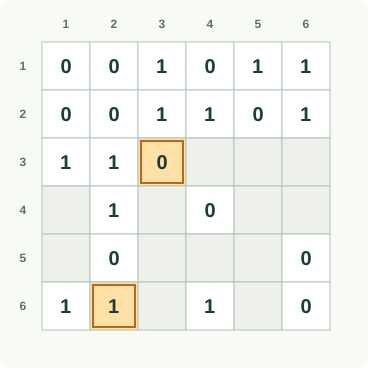
Step 4: Alternate row and column counts
Alternate row and column checks. Their required balance and ban on triples fix the remaining third-row digit, the lower third-column digit and the first fifth-row digit. Write R3C6=0, R6C3=0, R5C1=1.
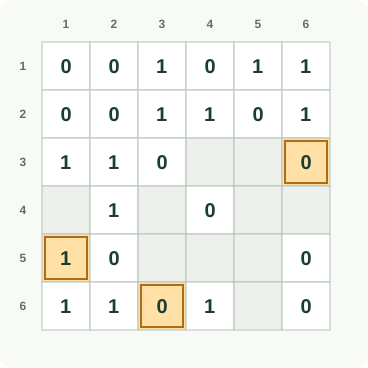
Step 5: Recheck the outer lines
Recheck the sixth row and sixth column after each placement. Their allowed patterns force these values, and the first column then determines its remaining zero. Write R6C5=0, R4C6=1, R4C1=0.
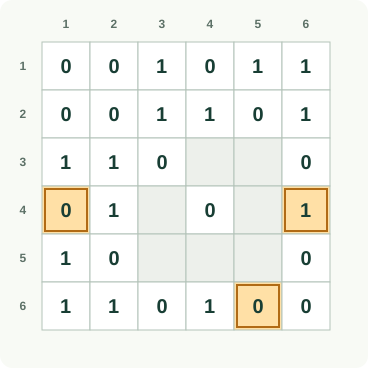
Step 6: Reject a duplicated-line alternative
Test the alternative 1 at R3C4: every continuation duplicates a completed line. Therefore write 0 there; row balance then fixes the neighboring 1. Write R3C4=0, R3C5=1.
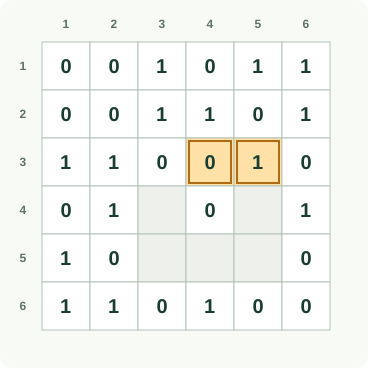
Step 7: Apply uniqueness again
The fourth column forces its next 1. Testing 1 at R4C3 would duplicate a line, so write 0 and propagate the third column. Write R5C4=1, R4C3=0, R5C3=1.
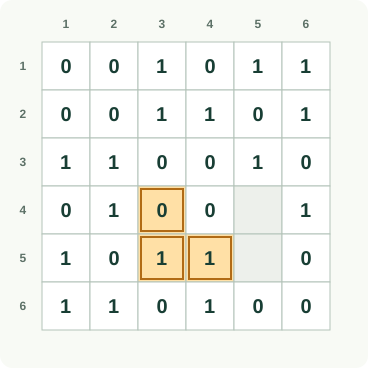
Step 8: Finish the balanced grid
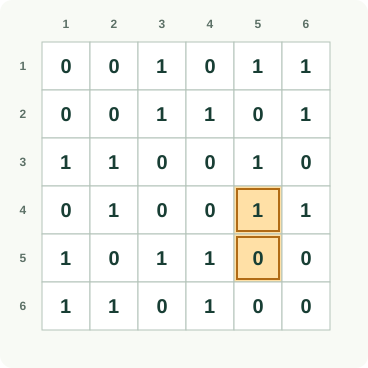
Finish the fourth and fifth rows using their three-of-each counts and triple restrictions. Finally compare all completed rows and columns for duplicates. Write R4C5=1, R5C5=0.
Use the beginner example to practice the update cycle
For each highlighted move in the worked puzzle, identify the affected three-cell window or count. Then inspect the perpendicular line before reading the next step. The same entry can be forced for one reason and useful for a different reason elsewhere. Learning that connection matters more than remembering the order of cells in one solved board.
- Set the line target to three zeros and three ones.
- Find adjacent equal pairs and fill their legal outward neighbors.
- Find matching endpoints with one blank and fill the gap.
- Complete any row or column that has reached one digit's quota.
- Update crossing lines after every new entry.
- Compare remaining full-line possibilities and reject exact duplicates.
Make a stalled puzzle easier to read
Stop and recount unfinished lines. A quota that was not reached on your previous scan may have become complete after a perpendicular move. Then scan pairs and gaps from the other direction. If neither helps, choose a nearly finished line and write its remaining possibilities explicitly, checking each against all three rules.
If a line has no legal completion, review the earliest entry whose explanation you cannot give. Common causes are miscounting a zero as a blank, extending a pair too far or forcing two rows to differ at a chosen cell without justification. Finish with separate row and column checks; solving all visible local patterns does not by itself verify uniqueness.
Sources and background
Worked example: follow each deduction
Read rows from top to bottom and columns from left to right, starting at 1. Read each instruction, then compare the orange changes with the previous picture. Keep undecided cells or segments open until the explanation settles them.
0 and 1 are digits; ? = undecided
Follow these changes in order; the picture below includes all of them.
Write 1 at row 3, column 1. For column 1, keep only patterns with 3 zeros, 3 ones and no three equal digits together, matching the fixed cells. They are 0 0 1 0 1 1 or 0 0 1 1 0 1. This position is 1 in every pattern.
Write 1 at row 6, column 1. For column 1, keep only patterns with 3 zeros, 3 ones and no three equal digits together, matching the fixed cells. They are 0 0 1 0 1 1 or 0 0 1 1 0 1. This position is 1 in every pattern.
Write 0 at row 2, column 5. For row 2, keep only patterns with 3 zeros, 3 ones and no three equal digits together, matching the fixed cells. They are 0 0 1 1 0 1. This position is 0 in every pattern.
Step 1: the orange outlines mark the changes explained above. Follow these changes in order; the picture below includes all of them.
Write 1 at row 2, column 6. For row 2, keep only patterns with 3 zeros, 3 ones and no three equal digits together, matching the fixed cells. They are 0 0 1 1 0 1. This position is 1 in every pattern.
Write 1 at row 3, column 2. For column 2, keep only patterns with 3 zeros, 3 ones and no three equal digits together, matching the fixed cells. They are 0 0 1 1 0 1. This position is 1 in every pattern.
Write 0 at row 5, column 2. For column 2, keep only patterns with 3 zeros, 3 ones and no three equal digits together, matching the fixed cells. They are 0 0 1 1 0 1. This position is 0 in every pattern.
Step 2: the orange outlines mark the changes explained above. Follow these changes in order; the picture below includes all of them.
Write 1 at row 6, column 2. For column 2, keep only patterns with 3 zeros, 3 ones and no three equal digits together, matching the fixed cells. They are 0 0 1 1 0 1. This position is 1 in every pattern.
Write 0 at row 3, column 3. For row 3, keep only patterns with 3 zeros, 3 ones and no three equal digits together, matching the fixed cells. They are 1 1 0 0 1 0 or 1 1 0 1 0 0. This position is 0 in every pattern.
Step 3: the orange outlines mark the changes explained above. Follow these changes in order; the picture below includes all of them.
Write 0 at row 3, column 6. For row 3, keep only patterns with 3 zeros, 3 ones and no three equal digits together, matching the fixed cells. They are 1 1 0 0 1 0 or 1 1 0 1 0 0. This position is 0 in every pattern.
Write 0 at row 6, column 3. For column 3, keep only patterns with 3 zeros, 3 ones and no three equal digits together, matching the fixed cells. They are 1 1 0 0 1 0 or 1 1 0 1 0 0. This position is 0 in every pattern.
Write 1 at row 5, column 1. For row 5, keep only patterns with 3 zeros, 3 ones and no three equal digits together, matching the fixed cells. They are 1 0 0 1 1 0 or 1 0 1 0 1 0 or 1 0 1 1 0 0. This position is 1 in every pattern.
Step 4: the orange outlines mark the changes explained above. Follow these changes in order; the picture below includes all of them.
Write 0 at row 6, column 5. For row 6, keep only patterns with 3 zeros, 3 ones and no three equal digits together, matching the fixed cells. They are 1 1 0 1 0 0. This position is 0 in every pattern.
Write 1 at row 4, column 6. For column 6, keep only patterns with 3 zeros, 3 ones and no three equal digits together, matching the fixed cells. They are 1 1 0 1 0 0. This position is 1 in every pattern.
Write 0 at row 4, column 1. For column 1, keep only patterns with 3 zeros, 3 ones and no three equal digits together, matching the fixed cells. They are 0 0 1 0 1 1. This position is 0 in every pattern.
Step 5: the orange outlines mark the changes explained above. Follow these changes in order; the picture below includes all of them.
Write 0 at row 3, column 4. This is a trial-and-contradiction step. Temporarily try 1 here and continue the rules from the current grid. Every continuation fails: two complete rows or two complete columns become identical. Undo that trial and use the stated choice.
Write 1 at row 3, column 5. For row 3, keep only patterns with 3 zeros, 3 ones and no three equal digits together, matching the fixed cells. They are 1 1 0 0 1 0. This position is 1 in every pattern.
Step 6: the orange outlines mark the changes explained above. Follow these changes in order; the picture below includes all of them.
Write 1 at row 5, column 4. For column 4, keep only patterns with 3 zeros, 3 ones and no three equal digits together, matching the fixed cells. They are 0 1 0 0 1 1. This position is 1 in every pattern.
Write 0 at row 4, column 3. This is a trial-and-contradiction step. Temporarily try 1 here and continue the rules from the current grid. Every continuation fails: two complete rows or two complete columns become identical. Undo that trial and use the stated choice.
Write 1 at row 5, column 3. For column 3, keep only patterns with 3 zeros, 3 ones and no three equal digits together, matching the fixed cells. They are 1 1 0 0 1 0. This position is 1 in every pattern.
Step 7: the orange outlines mark the changes explained above. Follow these changes in order; the picture below includes all of them.
Write 1 at row 4, column 5. For row 4, keep only patterns with 3 zeros, 3 ones and no three equal digits together, matching the fixed cells. They are 0 1 0 0 1 1. This position is 1 in every pattern.
Write 0 at row 5, column 5. For row 5, keep only patterns with 3 zeros, 3 ones and no three equal digits together, matching the fixed cells. They are 1 0 1 1 0 0. This position is 0 in every pattern.
Step 8: the orange outlines mark the changes explained above.
Frequently asked questions
Which Binary patterns should I learn first?
Learn equal-pair extension, matching-endpoint gap filling and quota completion. They come directly from the no-triples and balance rules. Scan them across rows and down columns, then update the crossing line after every new value.
Why is a zero not treated like a blank?
Zero is one of the puzzle's two actual symbols. A confirmed zero counts toward its line's quota and can form a pair or gap pattern. An empty cell has no confirmed symbol yet and must not be included in either count.
What should I do if both digits seem possible?
Keep the cell undecided. Look elsewhere for a pair, gap or completed quota, or list possible completions of its line. A value is forced only when every legal alternative has been excluded by a specific rule.