Nonogram · EN
How to Play Nonogram: Rules Explained
To play a Nonogram, fill cells so each row and column contains the consecutive filled runs listed by its clues, in the displayed order. Leave at least one empty cell between separate runs, and satisfy the row and column clues at the same time.
Read numbers as run lengths
A run is an uninterrupted group of filled cells in one line. A row clue of 3 means one run exactly three cells long, with every other cell in that row empty. A clue list of 2, 1 means a run of two filled cells followed later by a separate run of one. It does not mean simply filling any three cells.
Read row clues from left to right and column clues from top to bottom. The order matters: 2, 1 and 1, 2 describe different arrangements. Clues describe the full line, including runs near either edge. The spaces before, between and after runs may vary, but the filled lengths and their sequence must match exactly.
Separate runs with an empty cell
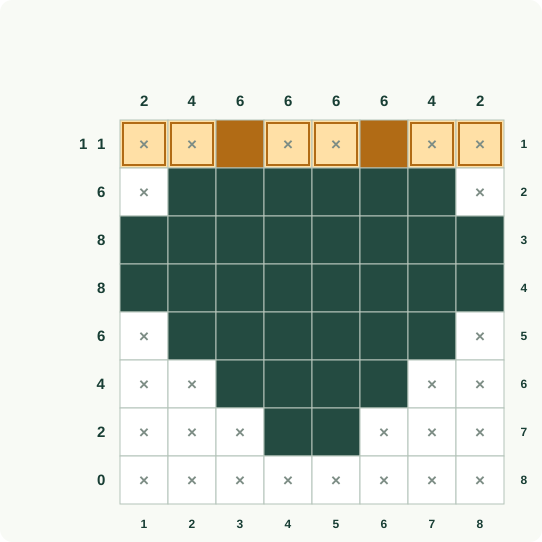
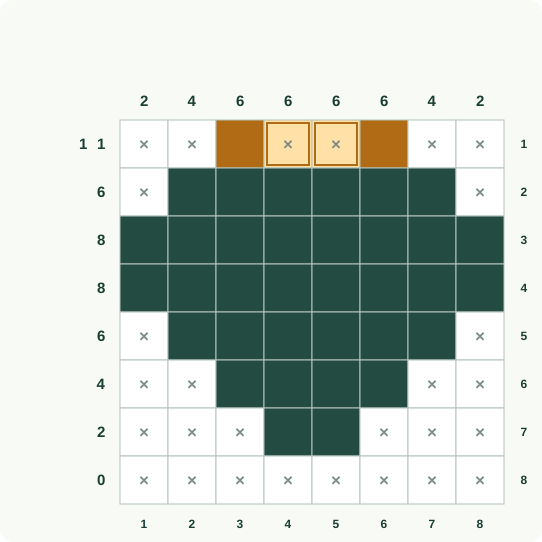
Two listed runs need at least one empty cell between them. If they touch, they merge into one longer run and no longer match the clue list. Extra empty cells are allowed between runs when the line has room. At the outer edges, no separator is required before the first run or after the last.
A line with k positive clues needs at least their sum plus k−1 cells. The extra k−1 cells are the mandatory separators. This minimum-space count helps determine whether runs can slide or must fit exactly. In the monochrome puzzle here, every pair of successive runs requires a gap; do not import special adjacency rules from colored Nonograms.
Distinguish filled, empty and undecided cells
A filled cell belongs to a run. A marked-empty cell cannot belong to any run. An undecided cell may still become either state. Keep those last two states distinct while solving: a blank-looking cell does not prove that a run has ended. Empty marks are positive information because they block possible run placements.
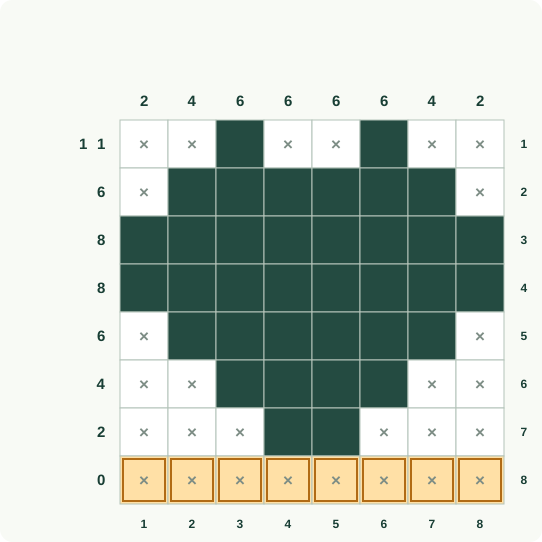
A clue of 0 means the entire line is empty. No filled run belongs there. Once every required run in a line is fully accounted for, its other cells are empty too. Count carefully before making that conclusion: a partially filled run may still need extension, and one finished run does not complete a line with several clues.
Use both directions for every cell
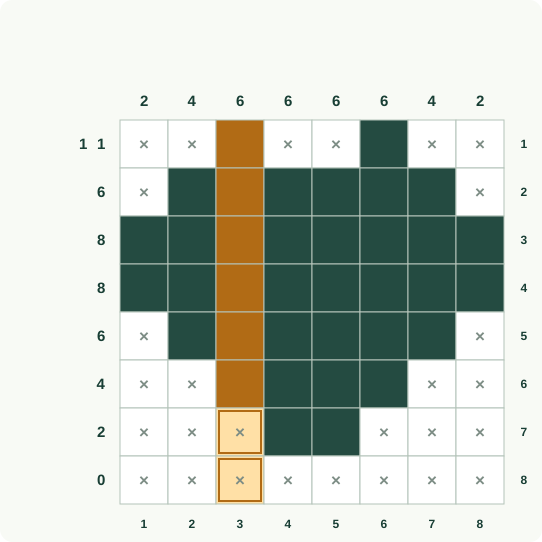
Each cell belongs to one row and one column. Filling it must be possible under both clue sets. A legal arrangement for a row can be rejected by its crossing columns, so do not finish a row arbitrarily just because it fits locally. The interaction between directions is the central source of deductions.
A useful early technique is overlap: compare the extreme legal positions of a run and identify cells that it must cover in either case. Fill only the cells guaranteed by every valid placement. The run's uncertain endpoints remain undecided until another clue narrows them. More complicated lines need all runs and their separators considered together.
Avoid picture-based guesses and premature completion
Many published Nonograms reveal recognizable pictures, and the names Picross, Griddlers, Hanjie and picture logic are often used for this family. Recognition can be enjoyable, but it is not a rule. A generated board may form an abstract pattern. Never add symmetry, eyes or outlines merely because a shape appears to be emerging.
Likewise, do not decide a run's identity from its length alone when several clues could explain it. A short filled segment may belong to a longer unfinished run. To mark separators around it, establish both its final length and which clue it satisfies. Incorrect empty marks can block the true solution as effectively as incorrect filled cells.
Verify a solved grid by reconstructing the clues
Read each completed row and count its filled runs from left to right. The resulting list must match the printed clue list exactly, including order. Repeat down every column. A correct total of filled cells is insufficient: the same total can be divided into runs in several different ways.
If one line fails, inspect its crossings and the earliest uncertain decision. Common causes are a missing separator, an off-by-one run length or treating an unfinished blank as known empty. The solved example is verified by these run rules, rather than by whether its final pattern resembles a particular object.
A short historical note
Puzzle publisher Conceptis describes the form's development in Japan through Non Ishida and Tetsuya Nishio in the late 1980s. Its history also records the later English name Nonograms and its own Pic-a-Pix publishing work. These names share the same central idea of ordered run clues describing a filled-cell pattern.
A solved example: check every rule
This completed example satisfies every puzzle rule. The individual highlights below identify the cells or edges that demonstrate each rule.
Dark cells are filled, crosses are confirmed empty and blank cells remain undecided. Orange marks highlight new decisions. Coordinate numbers appear below and to the right. Tinted squares remain undecided.
Sources and background
Frequently asked questions
What does a Nonogram clue such as 2, 1 mean?
It means one run of exactly two filled cells followed by one run of exactly one filled cell. At least one empty cell separates the runs. Their order is fixed, while the available empty space determines where they can fit.
Can two filled blocks touch?
If they represent separate clues in this monochrome puzzle, no: they need an empty cell between them. Cells within the same run touch side by side. Filled cells can also meet diagonally because there is no general diagonal prohibition.
Must the solution be a recognizable picture?
No. The logical solution is the cell pattern that satisfies every row and column clue. Many authored puzzles reveal pictures, but recognition and symmetry are not constraints. Use the clues to decide cells, including on abstract generated boards.