Futoshiki · EN
How to Play Futoshiki: Rules Explained
To play Futoshiki, fill an n×n grid with the numbers 1 to n so every row and column contains each number exactly once and every inequality sign is true. GooferThings uses a 5×5 board, so the available numbers are 1, 2, 3, 4 and 5.
Treat each row and column as a complete number set
Every cell receives one number. A completed row contains 1 through 5 without repetition, and so does a completed column. The printed starting numbers are fixed clues. You may not move or replace them to make another part of the grid work. Empty cells are unknown values, not zeros to include in a comparison.
Futoshiki has no Sudoku boxes unless a variant explicitly adds them. On this board, two equal numbers may occupy different rows and columns even when their cells sit close together. There is also no general diagonal uniqueness rule. Test a proposed value against its own row, its own column and the inequality clues that actually connect to it.
Read the open side of each sign
The wide, open side faces the larger value; the pointed side faces the smaller value. In the expression A < B, A must be smaller than B. In A > B, A must be larger. A vertical sign does the same job between the cells above and below it. Rotate the comparison mentally if that makes its direction clearer.
These are strict inequalities. Equal values never satisfy a sign, and the two numbers do not have to be consecutive. A value of 1 can be smaller than 3, 4 or 5 as well as 2. A blank gap between cells imposes no comparison: it does not imply equality, inequality or the reverse of a nearby sign.
Combine the clues instead of solving them separately
A number can satisfy its neighboring sign and still be wrong because it repeats in its column. Conversely, a value missing from a row may be excluded by an inequality. Each cell's candidates are the values that survive all its constraints together. Enter a number only when one candidate remains or when a particular number has only one possible place in a row or column.
A cell on the smaller side of a sign cannot contain 5, because the other cell would need a larger permitted number. A cell on the larger side cannot contain 1. These elementary bounds are useful even when neither cell has a fixed value. They narrow the range before row and column information chooses an exact number.
Understand chains of comparisons
Several signs can link into a strictly increasing chain. A chain of three cells needs three different values in increasing order. On a 1–5 board, its first cell is at most 3 and its last cell is at least 3. The middle cell is neither 1 nor 5. Those bounds come from leaving enough room for the values before and after it.
Follow only actual chains. If two cells are both smaller than a third cell, that alone does not order the two smaller cells relative to one another. They may even share a value when they are in different rows and columns and no other constraint forbids it. Branching signs provide bounds, but they are not automatically one long sequence.
Read a solved example in three passes
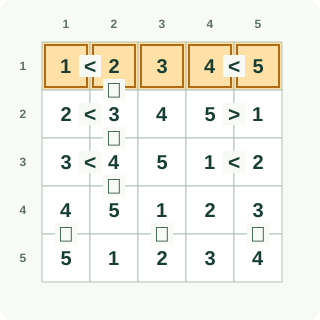
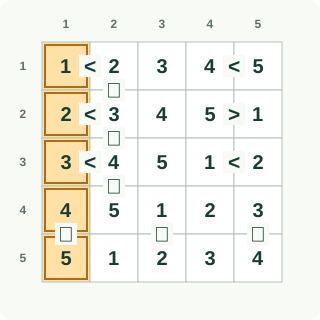
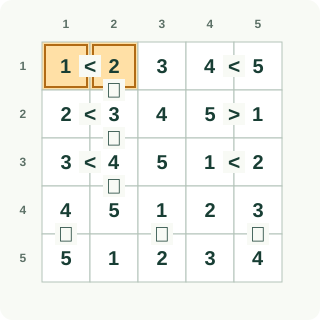
First check every row for the full set 1–5. Then check every column independently; a correct row does not guarantee correct columns. Finally read each printed inequality as a mathematical statement and verify its direction. The solved guide diagram illustrates these separate checks so that the row rules do not hide a reversed sign.
A finished grid is a Latin square with extra comparison constraints. That description explains the structure, but you do not need to know Latin-square mathematics to play. The practical task is to keep all candidate values consistent until each blank is determined by the clues.
Common mistakes to catch early
Do not interpret a greater-than sign as an instruction to subtract one. The gap between the two values may be larger than one. Do not place a missing row number before checking its column, and do not reject two nearby equal numbers merely because they would share a Sudoku box. Neither habit matches Futoshiki's actual rules.
When using notes, keep alternatives separate from confirmed values. Removing a candidate because of a guessed neighbor can produce a chain of plausible but unsupported entries. If a cell has no candidates, inspect the most recent placement and the direction of its signs. A reversed vertical sign is particularly easy to overlook when scanning quickly.
Names and a short publication note
Futoshiki is also called Unequal or an inequality puzzle. The Guardian introduced its Futoshiki puzzle in September 2006 as a Japanese logic game. That publication milestone is a useful historical reference without assigning a disputed single inventor to the whole puzzle form.
A solved example: check every rule
This completed example satisfies every puzzle rule. The individual highlights below identify the cells or edges that demonstrate each rule.
Printed inequalities stay fixed. Orange outlines show new digits; rows and columns are numbered from the top and left. Tinted squares remain undecided.
Sources and background
Frequently asked questions
Does Futoshiki use Sudoku boxes?
No. The standard puzzle here requires each number once per row and column, with additional inequality signs. There are no 3×3 boxes or smaller box constraints. Equal values are allowed when neither a shared row, shared column nor comparison forbids them.
Do numbers separated by a sign have to be consecutive?
No. A less-than or greater-than sign specifies only which value is smaller. Any two permitted numbers that make the statement true can satisfy it. Row, column and other sign constraints determine whether a particular pair is possible.
What numbers belong in a Futoshiki grid?
Use 1 through the grid's size: a 5×5 puzzle uses 1–5, while a 4×4 puzzle uses 1–4. Every row and column contains the complete set exactly once. GooferThings' current Futoshiki board uses 1–5.