Futoshiki · EN
Futoshiki Solving Strategies: Chains, Pairs and Candidate Support
To solve harder Futoshiki, propagate inequality bounds and row-column exclusions until only supported candidates remain. Then use pairs, longer chains and interactions between rows and columns to remove alternatives that basic singles cannot resolve.
Start with a consistent candidate model
Each empty cell has a domain: the numbers still allowed by its row, column and comparisons. On GooferThings that initial range is 1–5, with no Sudoku box constraint. A useful candidate must survive every applicable rule. After a removal, revisit the constraints it touches, because even a change that produces no single can tighten another cell's range.
Naked singles have one candidate; hidden singles give a number only one position in a row or column. Keep scanning for both after advanced deductions. Technique names describe the reason for a move, not a ladder you must climb once. A hard puzzle often alternates between a structural elimination and several straightforward placements.
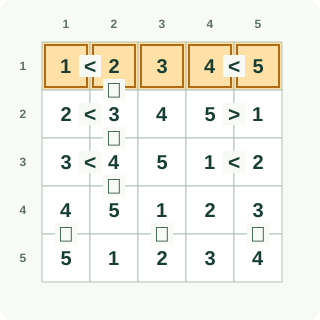
Chain bounds: reserve room for strict increases
For an increasing chain of k cells on a 1–n board, position i from the smaller end is at least i and at most n−k+i. These bounds follow because i−1 smaller values must fit before it and k−i larger values must fit after it. The chain may turn through rows and columns as long as every step follows a printed strict comparison.
Tighten those generic limits with current candidates. A high minimum at one end raises lower bounds downstream; a low maximum at the other end lowers upper bounds upstream. Repeat the process until no range changes. A branching comparison graph needs separate paths: two cells both below a third do not automatically have different values unless another rule requires it.
Candidate support: remove values with no legal partner
Consider two cells linked by A < B. Every candidate in A needs at least one larger candidate in B, and every candidate in B needs at least one smaller candidate in A. A candidate with no such partner is impossible. Apply this support test in both directions, then revisit the row and column after any removal.
For a single inequality, checking the smallest and largest candidates often performs this test quickly. The deeper value comes from repeated propagation through a network of signs and line constraints. Do not require one partner to support several mutually incompatible choices simultaneously; these are alternatives. A supported candidate is still merely possible, not confirmed.
Naked pairs and triples: reserve a small digit set
If two cells in one row are each limited to the same two numbers, those cells must use the pair in some order. Remove both numbers from every other cell in that row. The same principle works in a column. For a naked triple, three cells collectively have only three possible numbers, even when each individual cell has just two of them.
The cells must share the line in which you make the elimination. Two similarly restricted cells in unrelated rows and columns reserve nothing globally. Nor does a pair fix its internal order. After removing the reserved numbers elsewhere, inspect inequality neighbors: the reduced line candidates can strengthen signs outside the pair itself.
Hidden subsets: begin with the numbers instead
A hidden pair occurs when two numbers have possible positions only in the same two cells of a row or column. Those cells must hold the pair, so remove their other candidates. Unlike a naked pair, the cells may initially contain many extra notes. Scan each missing number's location set rather than looking only for cells with short lists.
The same logic extends to three numbers confined to three cells. It is especially useful when signs have excluded low or high values from most of a line. Verify that you inspected the complete row or column. An overlooked position means the proposed subset does not actually reserve those cells.
X-wing: compare one number across two lines
For one chosen number, suppose two rows each allow it only in the same two columns. Each row needs the number once, and each column can use it once, so the two copies occupy those columns between them. Remove the number from all other cells in those two columns. Reverse rows and columns for the transposed form.
This Latin-square deduction does not require Sudoku boxes. It uses two row requirements and two column limits, so it applies to Futoshiki unchanged. Use it after checking that neither row has an additional candidate for the number. The four intersection cells do not have to be otherwise identical; their other candidate values are irrelevant to this particular deduction.
Use contradiction chains carefully when stuck
A candidate can be disproved by a temporary assumption that leads to a definite violation: an empty domain, a repeated confirmed number, a broken inequality or a required digit with no position. Follow a short chain, state the precise contradiction, then restore the temporary entries and remove only the disproved candidate. Mere lack of progress is not a contradiction.
In the harder example, track how an inequality elimination changes a line subset and then produces a single. On your own grid, inspect the most constrained cells and signs first. Keep the reason for every removal recoverable. If the grid becomes inconsistent, the first unsupported removal is usually more useful to find than the last visible conflict.
A harder worked example
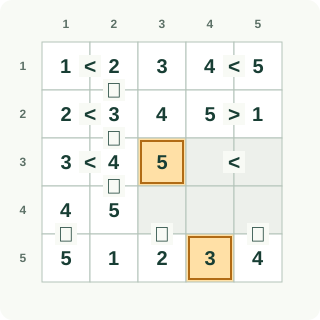
This board uses the Hard preset. Follow the four cumulative stages, revisiting each affected constraint after a deduction. Printed inequalities stay fixed. Orange outlines show new digits; rows and columns are numbered from the top and left. Tinted squares remain undecided.
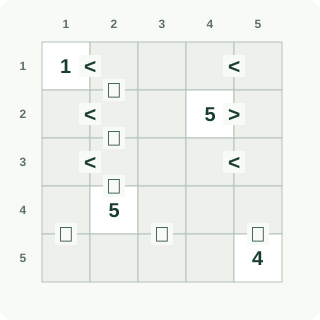
Worked stage 1
Read inequality chains as candidate bounds before filling cells. Intersect those bounds with missing row and column digits. The highlighted placements follow from the reduced domains; no ordinary Sudoku box rule applies to this five-by-five grid.
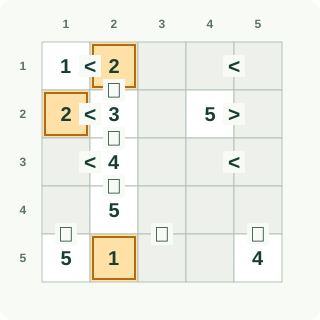
Worked stage 2
Revisit inequalities after each forced placement, especially the comparison between the fourth and fifth rows. Then use the first column and second row’s missing digits. Those values restrict crossing columns and determine the next upper-row cell.
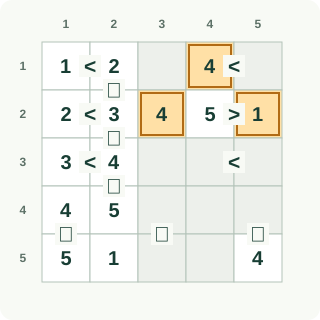
Worked stage 3
Use crossing column uniqueness to complete the top row’s ordered pair, then propagate into the third and fifth rows. A digit eliminated by an inequality stays a candidate deduction until only one legal value remains in that square.
Worked stage 4
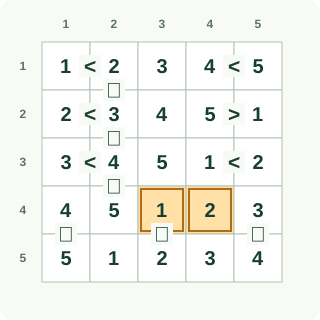
Finish the remaining vertical comparisons and missing row digits. Each final value must satisfy both its line and its inequality. Read every comparison again after completion, checking the smaller endpoint as well as the absence of repeated digits.
Sources and background
Worked example: follow each deduction
Read rows from top to bottom and columns from left to right, starting at 1. Read each instruction, then compare the orange changes with the previous picture. Keep undecided cells or segments open until the explanation settles them.
? = undecided
Follow these changes in order; the picture below includes all of them.
Write 4 at row 3, column 2. The sign requires row 3, column 2 < row 4, column 2. Compare the remaining numbers on its two sides: 4, 5 and 5. Only the stated number keeps the comparison true.
Write 5 at row 5, column 1. column 1 still needs 5. Every other position in that unit has ruled it out, so this is its only remaining place.
Write 3 at row 2, column 2. column 2 already contains 4, 5. Repetition is forbidden there. From this square’s remaining choices 3, 4, only 3 survives.
Write 1 at row 5, column 2. column 2 still needs 1. Every other position in that unit has ruled it out, so this is its only remaining place.
Write 2 at row 1, column 2. column 2 still needs 2. Every other position in that unit has ruled it out, so this is its only remaining place.
Write 2 at row 2, column 1. The sign requires row 2, column 1 < row 2, column 2. Compare the remaining numbers on its two sides: 2, 3, 4 and 3. Only the stated number keeps the comparison true.
Step 1: the orange outlines mark the changes explained above. Follow these changes in order; the picture below includes all of them.
Write 3 at row 3, column 1. column 1 already contains 1, 2, 5. Repetition is forbidden there. From this square’s remaining choices 2, 3, only 3 survives.
Write 4 at row 4, column 1. column 1 still needs 4. Every other position in that unit has ruled it out, so this is its only remaining place.
Write 1 at row 2, column 5. row 2 already contains 2, 3, 5. Repetition is forbidden there. From this square’s remaining choices 1, 2, 3, only 1 survives.
Write 4 at row 2, column 3. row 2 still needs 4. Every other position in that unit has ruled it out, so this is its only remaining place.
Write 4 at row 1, column 4. column 4 still needs 4. Every other position in that unit has ruled it out, so this is its only remaining place.
Step 2: the orange outlines mark the changes explained above. Follow these changes in order; the picture below includes all of them.
Write 5 at row 1, column 5. The sign requires row 1, column 4 < row 1, column 5. Compare the remaining numbers on its two sides: 4 and 3, 5. Only the stated number keeps the comparison true.
Write 3 at row 1, column 3. row 1 already contains 1, 2, 4, 5. Repetition is forbidden there. From this square’s remaining choices 3, 5, only 3 survives.
Write 2 at row 5, column 3. column 3 already contains 3, 4. Repetition is forbidden there. From this square’s remaining choices 2, 3, only 2 survives.
Write 5 at row 3, column 3. column 3 still needs 5. Every other position in that unit has ruled it out, so this is its only remaining place.
Write 3 at row 5, column 4. row 5 already contains 1, 2, 4, 5. Repetition is forbidden there. From this square’s remaining choices 2, 3, only 3 survives.
Step 3: the orange outlines mark the changes explained above. Follow these changes in order; the picture below includes all of them.
Write 2 at row 3, column 5. column 5 already contains 1, 4, 5. Repetition is forbidden there. From this square’s remaining choices 2, 5, only 2 survives.
Write 3 at row 4, column 5. column 5 still needs 3. Every other position in that unit has ruled it out, so this is its only remaining place.
Write 1 at row 3, column 4. The sign requires row 3, column 4 < row 3, column 5. Compare the remaining numbers on its two sides: 1, 2 and 2. Only the stated number keeps the comparison true.
Write 1 at row 4, column 3. The sign requires row 4, column 3 < row 5, column 3. Compare the remaining numbers on its two sides: 1, 2 and 2. Only the stated number keeps the comparison true.
Write 2 at row 4, column 4. row 4 already contains 1, 3, 4, 5. Repetition is forbidden there. From this square’s remaining choices 1, 2, 3, only 2 survives.
Step 4: the orange outlines mark the changes explained above.
Frequently asked questions
What is AB elimination in Futoshiki?
The term commonly describes subset reasoning, especially two cells reserved for two numbers. When a pair is genuinely confined to two cells in one row or column, those numbers can be eliminated elsewhere in that line. The pair's internal order remains unresolved.
Can Sudoku techniques be used in Futoshiki?
Row and column techniques such as singles, pairs and X-wings apply because both puzzles require each number once in those lines. Techniques that depend on Sudoku boxes need boxes, so they do not apply to the standard Futoshiki board here.
Does a long inequality chain always force exact numbers?
No. Its length imposes bounds, but several increasing sequences may fit the available range. Exact values follow only when the chain and other constraints leave one possibility. Preserve all supported alternatives until a deduction removes them.