Killer Sudoku · EN
How to Play Killer Sudoku: Rules Explained
To play Killer Sudoku, fill every row, column and box with the required digits exactly once, and make each outlined cage add to its clue without repeating a digit inside that cage. GooferThings uses a 6×6 board with digits 1–6 and boxes measuring two rows by three columns.
Keep Sudoku units and cages distinct
The six-cell rows, six-cell columns and 2×3 boxes each contain 1, 2, 3, 4, 5 and 6 exactly once. These are the ordinary Sudoku units for this smaller board. Do not use a 3×3 box rule here, and do not enter 7, 8 or 9. The complete digit range follows the displayed board size.
Cages are a second layer of outlined cell groups, each with an addition clue. A cage may cross a box boundary and need not fill a whole row or column. Its border defines exactly which cells contribute to its sum. Trace that border before counting cells; confusing a cage with a box changes both the arithmetic and the no-repeat checks.
Read the small cage number as a total
The clue is the sum of all digits in that cage. It is not a value to enter into the clue-bearing cell, and it is not the sum of the rest of the row. Every cage cell contributes once, including the cell carrying the printed clue. A single-cell cage directly fixes its cell to its total.
When some cage digits are known, subtract their sum from the clue to find the remaining total. The unfilled cells must supply that total using permitted, distinct digits. Subtraction alone does not decide their order. Row, column and box constraints determine which remaining cell can hold each member of a possible combination.
Do not repeat a digit within a cage
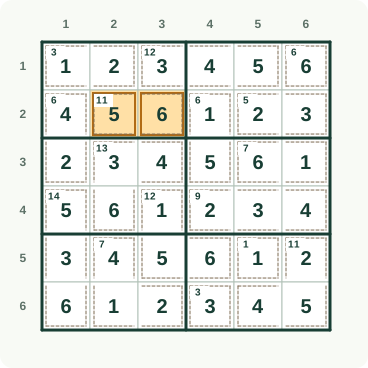
Cage digits are distinct even when two cage cells occupy different rows, columns and boxes. This adds a restriction beyond ordinary Sudoku. On a 1–6 board, a two-cell cage totaling 3 therefore contains 1 and 2; a two-cell cage totaling 11 contains 5 and 6. Their internal order still needs another deduction.
A sum can be arithmetically correct yet illegal. Repeating a digit to reach the target violates the cage rule, even if the row and column counts would allow it. Conversely, two different cages may reuse a digit when they do not conflict through a shared Sudoku unit. The no-repeat rule applies within each cage, not across all cages on the board.
Separate combinations from positions
A combination specifies which distinct digits form a cage total. A cell candidate specifies where a particular digit can go. A cage may have one possible digit set but several arrangements. Keep those arrangements open until crossing row, column or box information distinguishes them. Treating a known set as a known order is a common beginner error.
For each cage cell, keep only digits that belong to at least one legal cage arrangement and also survive its Sudoku constraints. A digit appearing in every combination is not necessarily fixed to a particular cell. It becomes a placement only when its position is forced, or when a cell has just one remaining candidate.
Use 21 here, and 45 on classic boards
Every complete row, column and box on this 6×6 board totals 21, because 1+2+3+4+5+6=21. This is the small-board counterpart of the familiar 45 rule in classic 9×9 Killer Sudoku, where 1 through 9 sum to 45. Use the total matching the actual digit range.
A set of cages covering all but one cell of a unit can sometimes reveal that missing value by subtraction. Count only cells actually inside the chosen unit. If a cage crosses its boundary, adding the entire cage introduces outside cells too, so you must account for those explicitly. A correct total requires a correct map of the cells being added.
Check every layer of a completed solution
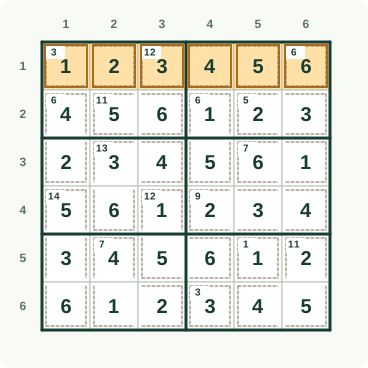
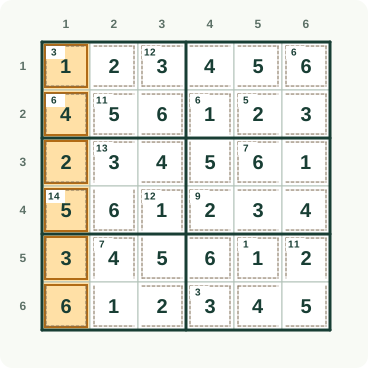
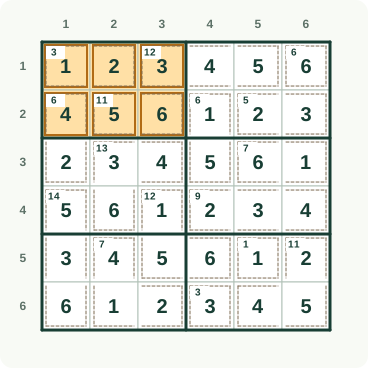
Read each row, column and 2×3 box for the complete 1–6 set. Then add every cage independently and inspect it for repeated digits. Correct cage totals do not guarantee valid Sudoku units, and valid units do not guarantee correct cage totals. The solved diagram highlights these checks separately.
If a cage has no possible distinct-digit combination, review the entries that produced its remaining sum. If the same digit is forced twice in a unit, review the candidate eliminations that led there. Find the first unsupported placement rather than changing several cells until the arithmetic happens to work.
Names and publication background
Killer Sudoku is also encountered as sum Sudoku, sumdoku or addoku. Contemporary reporting records The Times' Killer Sudoku launch on 31 August 2005. Puzzler Media's own 2008 sample documents the familiar combination of Sudoku units, summed cages and distinct digits within each cage.
A solved example: check every rule
This completed example satisfies every puzzle rule. The individual highlights below identify the cells or edges that demonstrate each rule.
Small numbers are cage totals, dotted lines mark cages and thick solid lines mark 2×3 boxes. Orange outlines show new digits. Tinted squares remain undecided.
Sources and background
Frequently asked questions
Can a number repeat in a Killer Sudoku cage?
No. Every cage uses distinct digits, including cages that cross row or box boundaries. This restriction applies in addition to the once-per-row, column and box rules. The same digit may appear in different cages when other constraints allow it.
Does the 45 rule apply to the GooferThings board?
Use 21 here because the board uses digits 1–6. Each complete row, column or 2×3 box totals 21. The total 45 belongs to a classic 9×9 board using 1–9; the same subtraction principle works with the correct total.
Does a cage total tell me the order of its digits?
Usually not. A unique combination tells you the digit set, while the row, column and box constraints help place its members. Preserve all legal arrangements until a specific cell or digit position becomes forced.