Killer Sudoku · EN
Killer Sudoku Solving Strategies: Cage Sets, Innies and Outies
Solve harder Killer Sudoku by maintaining complete cage combinations and combining them with Sudoku unit restrictions. Use restrictive sums and singles first, then cage-unit locks, unit totals, innies and outies to obtain deductions that neither arithmetic nor Sudoku scanning provides alone.
Combination filtering: keep sets and arrangements distinct
A cage combination lists its distinct digits; an arrangement places those digits in its cells. Both levels matter. Remove a combination when no arrangement of it can satisfy all the row, column and box constraints. Then remove a cell candidate if no surviving arrangement places that digit there. This is stronger than treating the sum and each cell independently.
On GooferThings the range is 1–6. A lookup or mental shortcut designed for 1–9 must be recalculated. After a confirmed digit, subtract it from the cage total and exclude it from the remaining cage cells. Refilter the whole cage, then propagate candidate changes through its Sudoku units. Advanced progress often appears as an ordinary single after this update.
Bounds and mandatory digits: exploit restrictive arithmetic
For k distinct digits from 1–6, the smallest possible total is the sum of the k smallest available digits, and the largest is the sum of the k largest. Use currently available digits, excluding cage repeats and incompatible cell positions. A remaining total outside those bounds exposes a contradiction; a total at a tight bound may determine the digit set.
A digit present in every surviving combination is mandatory somewhere in the cage. That does not place it automatically. Compare the cells that can take it: if only one remains, place it. If several remain, their shared row, column or box may still supply an elimination outside the cage.
Cage-unit locks: a required digit reserves a position group
If a mandatory cage digit can occur only in cells belonging to one row, the digit must appear in that row within the cage. Remove it from the row's other cells. The same logic applies to columns and boxes. This combines a cage requirement with the Sudoku rule that a unit contains each digit only once.
Also scan from the unit toward the cage. If every candidate for a required unit digit lies inside one cage, that digit must occur in the cage and cannot appear in its other cells. Do not apply the first direction to a digit that occurs in only some cage combinations: being possible somewhere is different from being required somewhere.
The unit-total rule: 21 on this board
Each complete 1–6 row, column and 2×3 box totals 21. Two disjoint complete units total 42, and so on. Compare those fixed totals with cage sums to isolate unknown cells or small cell groups. On classic 9×9 puzzles the corresponding single-unit total is 45; the arithmetic principle transfers, but the constant changes.
Choose unions of disjoint units or explicitly account for shared cells. Adding a row total and a column total counts their intersection twice. Similarly, adding overlapping cage fragments without their own known sums is unjustified. Draw the selected cell set mentally or on the guide diagram and count each intended contribution exactly once.
Innies and outies: track the boundary precisely
An innie is a cell inside a chosen unit or unit group that is isolated by subtracting the totals of complete cages contained within it. If those cages cover all but one cell, subtract their sum from the unit total to obtain that cell. With several uncovered cells, the subtraction gives their combined total, not their individual values.
An outie lies outside the chosen unit. If whole cages collectively cover every cell of the unit plus some outside cells, subtract the unit total from those cage totals. The remainder is the sum of the outside cells. A single outside cell becomes an entry; multiple outies need additional constraints. Confirm exact coverage, and include no unrelated cage cells unnoticed.
Use derived sums without inventing new no-repeat rules
A derived group total can be very useful, but its cells do not automatically become a new cage. Distinctness follows only when the cells share an actual row, column, box or cage, or when another deduction proves it. Two unrelated outies may repeat a digit even though a printed cage could not. Their combinations must reflect their real relationships.
In the harder worked example, follow each boundary calculation and name the cells it leaves inside or outside. Then apply ordinary cage filtering and Sudoku singles again. If stuck, revisit the smallest surviving combination lists and the clearest unit boundaries. A short explicit contradiction can disprove a candidate, but a difficult-looking remainder does not. Verify all original cages at the end, including any used indirectly in a total argument.
A harder worked example
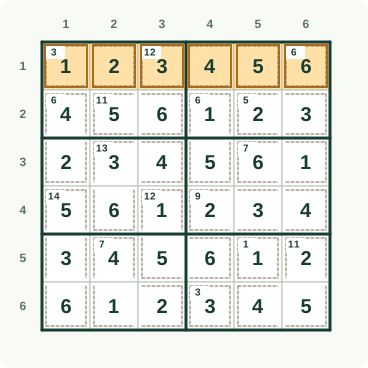
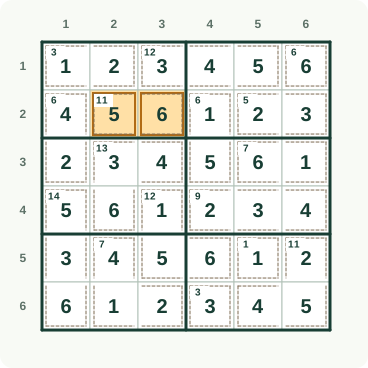
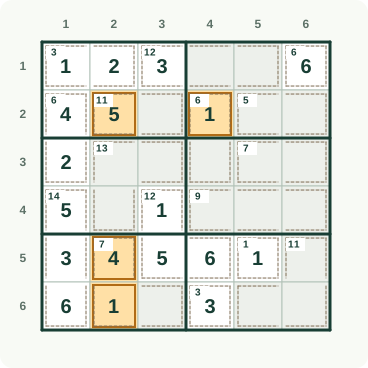
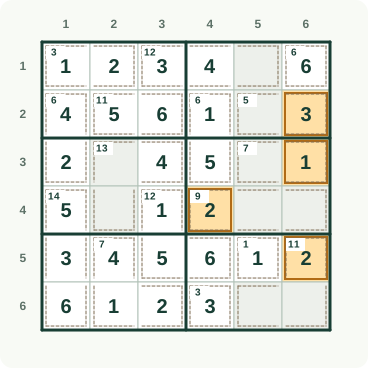
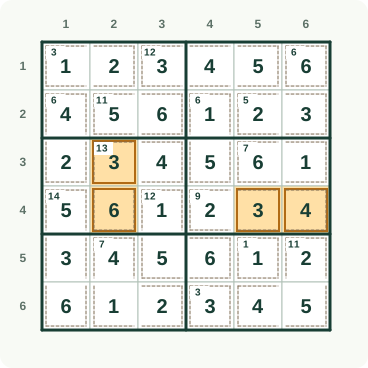
This board uses the Hard preset. Follow the four cumulative stages, revisiting each affected constraint after a deduction. Small numbers are cage totals, dotted lines mark cages and thick solid lines mark 2×3 boxes. Orange outlines show new digits. Tinted squares remain undecided.
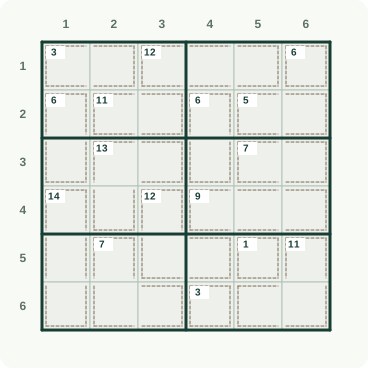
Worked stage 1
Use the single-cell cages first, then enumerate non-repeating combinations for the other totals. Intersect those combinations with row, column and box restrictions. Only a single remaining value is written; other narrowed combinations remain candidates for later deductions.
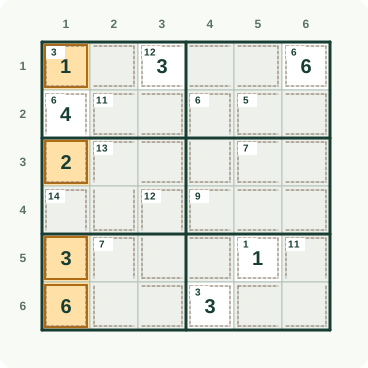
Worked stage 2
The first boxes and crossing lines now have restricted missing digits. Fill their forced cells, then revisit the sum cages that contain them. Each established digit reduces the cage remainder and can remove combinations even outside that box.
Worked stage 3
Alternate missing-digit checks in rows and columns. The highlighted central values now have only one legal position after the earlier box placements. Preserve each cage’s distinct-digit condition when using its remaining total; a repeated addend is never allowed.
Worked stage 4
Finish the remaining 2×3 boxes, then use their placements to settle the last cage remainders. Check every row and column contains 1–6 once, each box does too and each cage matches its printed total without a repeated digit.
Sources and background
Worked example: follow each deduction
Read rows from top to bottom and columns from left to right, starting at 1. Read each instruction, then compare the orange changes with the previous picture. Keep undecided cells or segments open until the explanation settles them. This 6×6 number example uses digits 1–6, once in each row and column. Its boxes contain 2×3 cells.
? = undecided
Follow these changes in order; the picture below includes all of them.
Write 1 at row 5, column 5. Check the cells of the run or outlined cage marked 1. Their values must meet that arithmetic clue and the crossing restrictions. In cell order row 5, column 5, the remaining arrangements are (1); they all give 1 here.
Write 3 at row 6, column 4. Check the cells of the run or outlined cage marked 3. Their values must meet that arithmetic clue and the crossing restrictions. In cell order row 6, column 4, the remaining arrangements are (3); they all give 3 here.
Write 6 at row 1, column 6. Check the cells of the run or outlined cage marked 6. Their values must meet that arithmetic clue and the crossing restrictions. In cell order row 1, column 6, the remaining arrangements are (6); they all give 6 here.
Write 3 at row 1, column 3. the 2×3 box starting at row 1, column 1 still needs 3. Every other position in that unit has ruled it out, so this is its only remaining place.
Write 4 at row 2, column 1. the 2×3 box starting at row 1, column 1 still needs 4. Every other position in that unit has ruled it out, so this is its only remaining place.
Write 2 at row 3, column 1. Check the cells of the run or outlined cage marked 6. Their values must meet that arithmetic clue and the crossing restrictions. In cell order row 3, column 1; row 2, column 1, the remaining arrangements are (2, 4); they all give 2 here.
Write 1 at row 1, column 1. column 1 already contains 2, 4. Repetition is forbidden there. From this square’s remaining choices 1, 2, only 1 survives.
Write 3 at row 5, column 1. row 5 still needs 3. Every other position in that unit has ruled it out, so this is its only remaining place.
Write 6 at row 6, column 1. row 6 still needs 6. Every other position in that unit has ruled it out, so this is its only remaining place.
Step 1: the orange outlines mark the changes explained above. Follow these changes in order; the picture below includes all of them.
Write 2 at row 1, column 2. the 2×3 box starting at row 1, column 1 already contains 1, 3, 4. Repetition is forbidden there. From this square’s remaining choices 1, 2, only 2 survives.
Write 1 at row 4, column 3. the 2×3 box starting at row 3, column 1 still needs 1. Every other position in that unit has ruled it out, so this is its only remaining place.
Write 5 at row 5, column 3. the 2×3 box starting at row 5, column 1 still needs 5. Every other position in that unit has ruled it out, so this is its only remaining place.
Write 6 at row 5, column 4. the 2×3 box starting at row 5, column 4 still needs 6. Every other position in that unit has ruled it out, so this is its only remaining place.
Write 5 at row 4, column 1. Check the cells of the run or outlined cage marked 14. Their values must meet that arithmetic clue and the crossing restrictions. In cell order row 5, column 1; row 4, column 1; row 6, column 1, the remaining arrangements are (3, 5, 6); they all give 5 here.
Write 1 at row 2, column 4. row 2 still needs 1. Every other position in that unit has ruled it out, so this is its only remaining place.
Write 4 at row 5, column 2. column 2 already contains 2. Repetition is forbidden there. From this square’s remaining choices 2, 4, only 4 survives.
Write 1 at row 6, column 2. column 2 still needs 1. Every other position in that unit has ruled it out, so this is its only remaining place.
Write 5 at row 2, column 2. column 2 still needs 5. Every other position in that unit has ruled it out, so this is its only remaining place.
Step 2: the orange outlines mark the changes explained above. Follow these changes in order; the picture below includes all of them.
Write 5 at row 3, column 4. row 3 still needs 5. Every other position in that unit has ruled it out, so this is its only remaining place.
Write 6 at row 2, column 3. column 3 already contains 1, 3, 5. Repetition is forbidden there. From this square’s remaining choices 5, 6, only 6 survives.
Write 2 at row 6, column 3. column 3 still needs 2. Every other position in that unit has ruled it out, so this is its only remaining place.
Write 4 at row 3, column 3. column 3 still needs 4. Every other position in that unit has ruled it out, so this is its only remaining place.
Write 4 at row 1, column 4. column 4 already contains 1, 3, 5, 6. Repetition is forbidden there. From this square’s remaining choices 4, 5, only 4 survives.
Write 2 at row 4, column 4. column 4 still needs 2. Every other position in that unit has ruled it out, so this is its only remaining place.
Write 2 at row 5, column 6. row 5 already contains 1, 3, 4, 5, 6. Repetition is forbidden there. From this square’s remaining choices 2, 4, 5, only 2 survives.
Write 3 at row 2, column 6. column 6 already contains 2, 6. Repetition is forbidden there. From this square’s remaining choices 2, 3, only 3 survives.
Write 1 at row 3, column 6. column 6 still needs 1. Every other position in that unit has ruled it out, so this is its only remaining place.
Step 3: the orange outlines mark the changes explained above. Follow these changes in order; the picture below includes all of them.
Write 5 at row 6, column 6. column 6 still needs 5. Every other position in that unit has ruled it out, so this is its only remaining place.
Write 5 at row 1, column 5. the 2×3 box starting at row 1, column 4 already contains 1, 3, 4, 6. Repetition is forbidden there. From this square’s remaining choices 4, 5, only 5 survives.
Write 2 at row 2, column 5. the 2×3 box starting at row 1, column 4 already contains 1, 3, 4, 6. Repetition is forbidden there. From this square’s remaining choices 2, 3, only 2 survives.
Write 4 at row 6, column 5. the 2×3 box starting at row 5, column 4 already contains 1, 2, 3, 5, 6. Repetition is forbidden there. From this square’s remaining choices 4, 5, only 4 survives.
Write 6 at row 3, column 5. Check the cells of the run or outlined cage marked 7. Their values must meet that arithmetic clue and the crossing restrictions. In cell order row 3, column 6; row 3, column 5, the remaining arrangements are (1, 6); they all give 6 here.
Write 3 at row 3, column 2. row 3 already contains 1, 2, 4, 5, 6. Repetition is forbidden there. From this square’s remaining choices 3, 6, only 3 survives.
Write 6 at row 4, column 2. row 4 still needs 6. Every other position in that unit has ruled it out, so this is its only remaining place.
Write 3 at row 4, column 5. column 5 already contains 1, 2, 4, 5, 6. Repetition is forbidden there. From this square’s remaining choices 3, 4, only 3 survives.
Write 4 at row 4, column 6. column 6 already contains 1, 2, 3, 5, 6. Repetition is forbidden there. From this square’s remaining choices 3, 4, only 4 survives.
Step 4: the orange outlines mark the changes explained above.
Frequently asked questions
What is an innie in Killer Sudoku?
An innie is an inside cell or cell group isolated by comparing a complete unit's known total with cage sums contained within it. A single uncovered cell is determined by subtraction. Several uncovered cells yield a combined total that still needs solving.
What is an outie?
An outie is outside a selected unit whose cells are covered by whole cages. When those cages cover the entire unit plus outside cells, subtracting the unit total gives the outside cells' total. Track every included cell so the subtraction counts the intended set.
Can digits repeat in a derived sum group?
Sometimes. A derived group is not automatically a printed cage. Its cells cannot repeat only when their actual row, column, box or cage relationships forbid it. Use those relationships when listing combinations instead of importing a no-repeat rule that the group does not have.