Killer Sudoku · EN
Killer Sudoku for Beginners: Start with Cages and Crossings
Begin Killer Sudoku with single-cell cages and sums that allow very few distinct-digit combinations, then use Sudoku rows, columns and boxes to place those digits. On the 6×6 GooferThings board, use 1–6, 2×3 boxes and a total of 21 for each complete Sudoku unit.
Read one cage completely before calculating
Trace its outline and count its cells. The printed clue totals every cell inside, including the cell bearing that clue. A cage can cross a box boundary, so the bold Sudoku box lines and cage outlines perform different jobs. Confirm which cells you are adding before writing any candidates.
A single-cell cage is the simplest opening: its one value equals its clue. Enter that digit, then remove it from the other cells in its row, column, 2×3 box and cage where relevant. Even a direct arithmetic clue has Sudoku consequences. Follow those consequences before hunting for a more complicated sum.
First deduction: recognize restrictive combinations
Use distinct digits from 1–6. A two-cell cage totaling 3 must contain 1 and 2, while a two-cell cage totaling 11 must contain 5 and 6. A three-cell cage totaling 6 contains 1, 2 and 3; a three-cell cage totaling 15 contains 4, 5 and 6. These extreme sums leave very little freedom.
Write the digit set as possibilities in each cage cell rather than assigning an arbitrary order. The cage clue has identified the members, not their positions. A row or column containing one of those digits may eliminate it from a cage cell and reveal where another member must go.
Second deduction: intersect cage and Sudoku candidates
A cage cell must satisfy its arithmetic possibilities and its row, column and box restrictions simultaneously. Remove digits already confirmed in any of those Sudoku units. If one candidate remains, you have a naked single. If a required digit has only one possible position in a unit, you have a hidden single.
After a placement, update the entire cage combination as well as the crossing units. It may rule out a whole digit set, rather than simply removing one candidate from one cell. Keep at least one complete legal arrangement for the cage; individually plausible cell candidates can otherwise conceal an impossible combined total.
Third deduction: calculate a remaining cage total
Subtract the confirmed cage digits from its clue. If one cage cell remains, its value equals the remaining total. Check that the value is in 1–6, does not repeat inside the cage and is legal in its row, column and box. Arithmetic supplies a candidate, while those other checks confirm its consistency.
With two or more blanks, list all distinct-digit combinations that make the remaining total, excluding values already used in the cage. Do not settle for the first combination you notice. Crossing restrictions may remove some combinations and order the survivors, but a plausible sum alone is not a placement.
Fourth deduction: use a complete unit's total of 21
Each row, column and 2×3 box contains 1–6 once, so each totals 21. When complete cages lie entirely inside a unit and leave only one uncovered cell, subtract their totals from 21 to find that cell. This is often called an innie: an inside cell obtained by comparing cage coverage with a known unit total.
Check the coverage before subtracting. A crossing cage includes outside cells, so its entire total cannot be treated as if it were inside the unit. Beginners should start with boundaries that are easy to trace. The classic 45 rule uses the same idea on 1–9 boards; using 45 on this smaller board gives incorrect results.
Start with this easy puzzle
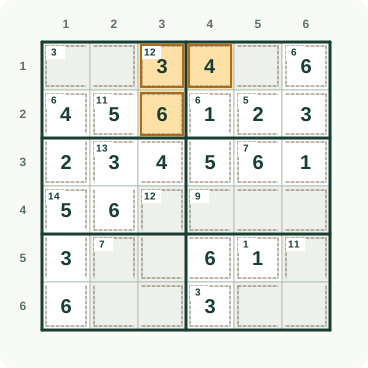
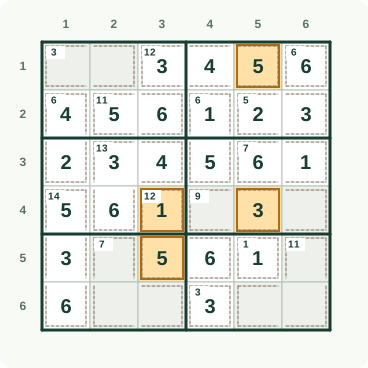
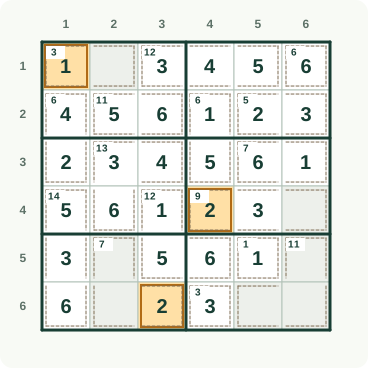
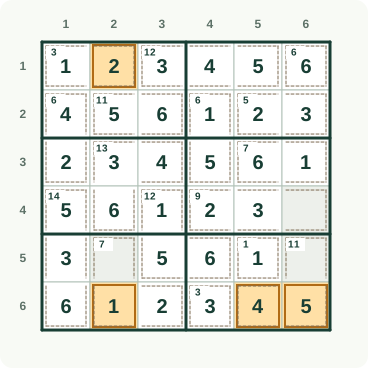
Small numbers are cage totals, dotted lines mark cages and thick solid lines mark 2×3 boxes. Orange outlines show new digits. Tinted squares remain undecided.
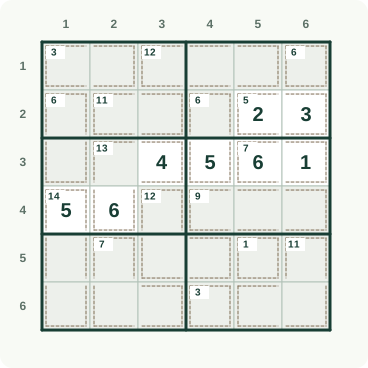
Step 1: Combine cages with fixed values
Use cage sums without repeated digits to reduce combinations. The single-cell cages supply fixed values, while intersecting cages and givens force the other highlighted placements. Write R3C2=3, R2C4=1, R5C5=1, R6C4=3.
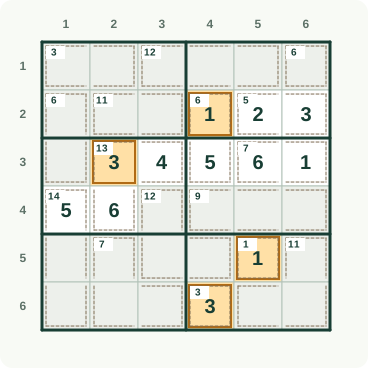
Step 2: Cross the first line deductions
Place the remaining single-cell cage value, then use missing digits in the first column and second row. Cage totals remain constraints on the unfilled cells. Write R1C6=6, R2C1=4, R2C2=5.
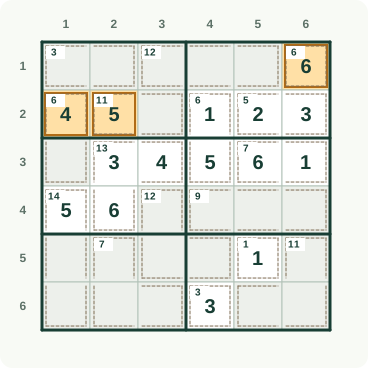
Step 3: Use row and column missing digits
Cross-check row and column missing digits. Each highlighted cell now has one legal value after removing digits already present in its crossing units. Write R3C1=2, R5C4=6, R5C1=3, R6C1=6.
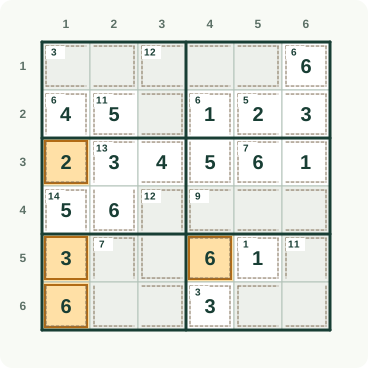
Step 4: Apply the upper box restrictions
Finish the forced line values, then use the upper 2×3 boxes. Each box must contain 1–6 exactly once, giving the highlighted top-row placements. Write R2C3=6, R1C3=3, R1C4=4.
Step 5: Propagate through the 2×3 boxes
Carry box exclusions through the remaining outlined 2×3 areas. A digit used anywhere inside a box is unavailable to every other cell in that box. Write R1C5=5, R4C3=1, R4C5=3, R5C3=5.
Step 6: Complete the crossing columns
Revisit the first, third and fourth columns after the box placements. Their remaining missing digits now occupy only the highlighted positions. Write R1C1=1, R6C3=2, R4C4=2.
Step 7: Revisit the lower rows
Complete the lower row and column values, then finish the upper-left box. Check cage totals as you go; equal sums do not permit repeated digits. Write R6C5=4, R6C2=1, R6C6=5, R1C2=2.
Step 8: Finish every box and cage
Finish the remaining 2×3 boxes using their missing digits. Recheck every row, column and cage after these final placements to confirm the complete solution. Write R4C6=4, R5C2=4, R5C6=2.
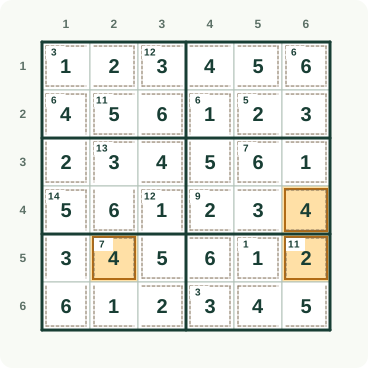
Work through the example and recover from a stall
At each illustrated step, identify the cage's remaining total, its legal distinct-digit sets and the Sudoku restriction that chooses a cell. Distinguish a combination deduction from a placement. Notice how a confirmed digit changes both the cage arithmetic and several Sudoku units, creating a chain of simpler moves.
When stuck, rescan single-cell and nearly completed cages, then rows or boxes missing only a few digits. Recompute one restrictive cage rather than guessing its order. If a contradiction appears, check cage boundaries, repeated cage digits and the last unproved candidate removal. Finish by checking every unit and every cage independently; all conditions must hold together.
Sources and background
Worked example: follow each deduction
Read rows from top to bottom and columns from left to right, starting at 1. Read each instruction, then compare the orange changes with the previous picture. Keep undecided cells or segments open until the explanation settles them. This 6×6 number example uses digits 1–6, once in each row and column. Its boxes contain 2×3 cells.
? = undecided
Follow these changes in order; the picture below includes all of them.
Write 3 at row 3, column 2. Check the cells of the run or outlined cage marked 13. Their values must meet that arithmetic clue and the crossing restrictions. In cell order row 3, column 3; row 3, column 2; row 4, column 2, the remaining arrangements are (4, 3, 6); they all give 3 here.
Write 1 at row 2, column 4. Check the cells of the run or outlined cage marked 6. Their values must meet that arithmetic clue and the crossing restrictions. In cell order row 2, column 4; row 3, column 4, the remaining arrangements are (1, 5); they all give 1 here.
Write 1 at row 5, column 5. Check the cells of the run or outlined cage marked 1. Their values must meet that arithmetic clue and the crossing restrictions. In cell order row 5, column 5, the remaining arrangements are (1); they all give 1 here.
Write 3 at row 6, column 4. Check the cells of the run or outlined cage marked 3. Their values must meet that arithmetic clue and the crossing restrictions. In cell order row 6, column 4, the remaining arrangements are (3); they all give 3 here.
Step 1: the orange outlines mark the changes explained above. Follow these changes in order; the picture below includes all of them.
Write 6 at row 1, column 6. Check the cells of the run or outlined cage marked 6. Their values must meet that arithmetic clue and the crossing restrictions. In cell order row 1, column 6, the remaining arrangements are (6); they all give 6 here.
Write 4 at row 2, column 1. row 2 already contains 1, 2, 3. Repetition is forbidden there. From this square’s remaining choices 1, 2, 4, only 4 survives.
Write 5 at row 2, column 2. column 2 already contains 3, 6. Repetition is forbidden there. From this square’s remaining choices 5, 6, only 5 survives.
Step 2: the orange outlines mark the changes explained above. Follow these changes in order; the picture below includes all of them.
Write 2 at row 3, column 1. row 3 already contains 1, 3, 4, 5, 6. Repetition is forbidden there. From this square’s remaining choices 1, 2, 4, only 2 survives.
Write 6 at row 5, column 4. column 4 still needs 6. Every other position in that unit has ruled it out, so this is its only remaining place.
Write 3 at row 5, column 1. row 5 already contains 1, 6. Repetition is forbidden there. From this square’s remaining choices 3, 6, only 3 survives.
Write 6 at row 6, column 1. row 6 already contains 3. Repetition is forbidden there. From this square’s remaining choices 3, 6, only 6 survives.
Step 3: the orange outlines mark the changes explained above. Follow these changes in order; the picture below includes all of them.
Write 6 at row 2, column 3. the 2×3 box starting at row 1, column 1 already contains 4, 5. Repetition is forbidden there. From this square’s remaining choices 5, 6, only 6 survives.
Write 3 at row 1, column 3. the 2×3 box starting at row 1, column 1 still needs 3. Every other position in that unit has ruled it out, so this is its only remaining place.
Write 4 at row 1, column 4. the 2×3 box starting at row 1, column 4 already contains 1, 2, 3, 6. Repetition is forbidden there. From this square’s remaining choices 2, 4, only 4 survives.
Step 4: the orange outlines mark the changes explained above. Follow these changes in order; the picture below includes all of them.
Write 5 at row 1, column 5. the 2×3 box starting at row 1, column 4 still needs 5. Every other position in that unit has ruled it out, so this is its only remaining place.
Write 1 at row 4, column 3. the 2×3 box starting at row 3, column 1 already contains 2, 3, 4, 5, 6. Repetition is forbidden there. From this square’s remaining choices 1, 2, 3, only 1 survives.
Write 3 at row 4, column 5. the 2×3 box starting at row 3, column 4 still needs 3. Every other position in that unit has ruled it out, so this is its only remaining place.
Write 5 at row 5, column 3. the 2×3 box starting at row 5, column 1 still needs 5. Every other position in that unit has ruled it out, so this is its only remaining place.
Step 5: the orange outlines mark the changes explained above. Follow these changes in order; the picture below includes all of them.
Write 1 at row 1, column 1. column 1 already contains 2, 3, 4, 5, 6. Repetition is forbidden there. From this square’s remaining choices 1, 2, only 1 survives.
Write 2 at row 6, column 3. column 3 already contains 1, 3, 4, 5, 6. Repetition is forbidden there. From this square’s remaining choices 1, 2, only 2 survives.
Write 2 at row 4, column 4. column 4 already contains 1, 3, 4, 5, 6. Repetition is forbidden there. From this square’s remaining choices 2, 4, only 2 survives.
Step 6: the orange outlines mark the changes explained above. Follow these changes in order; the picture below includes all of them.
Write 4 at row 6, column 5. column 5 already contains 1, 2, 3, 5, 6. Repetition is forbidden there. From this square’s remaining choices 4, 5, only 4 survives.
Write 1 at row 6, column 2. row 6 already contains 2, 3, 4, 6. Repetition is forbidden there. From this square’s remaining choices 1, 2, 4, only 1 survives.
Write 5 at row 6, column 6. row 6 already contains 2, 3, 4, 6. Repetition is forbidden there. From this square’s remaining choices 2, 4, 5, only 5 survives.
Write 2 at row 1, column 2. the 2×3 box starting at row 1, column 1 already contains 1, 3, 4, 5, 6. Repetition is forbidden there. From this square’s remaining choices 1, 2, only 2 survives.
Step 7: the orange outlines mark the changes explained above. Follow these changes in order; the picture below includes all of them.
Write 4 at row 4, column 6. the 2×3 box starting at row 3, column 4 already contains 1, 2, 3, 5, 6. Repetition is forbidden there. From this square’s remaining choices 2, 4, only 4 survives.
Write 4 at row 5, column 2. the 2×3 box starting at row 5, column 1 already contains 1, 2, 3, 5, 6. Repetition is forbidden there. From this square’s remaining choices 2, 4, only 4 survives.
Write 2 at row 5, column 6. the 2×3 box starting at row 5, column 4 already contains 1, 3, 4, 5, 6. Repetition is forbidden there. From this square’s remaining choices 2, 4, only 2 survives.
Step 8: the orange outlines mark the changes explained above.
Frequently asked questions
Do I need to memorize Killer Sudoku combinations?
No. Start by working out small cages and extreme sums with distinct digits. Remembering a few sets makes scanning faster, but their positions still depend on crossing constraints. Use the 1–6 range for this board rather than a 1–9 combination table.
Why can I know a cage's digits without placing them?
The sum can force one digit set while allowing several orders. Each cage cell must also satisfy its row, column and box. Keep the set as candidates until those crossing constraints identify a unique position or eliminate an arrangement.
Where should I look when a beginner Killer Sudoku stalls?
Revisit cages with one blank, restrictive two-cell cages and nearly completed Sudoku units. Update each cage's remaining sum and remove used digits. Then check whether a unit-total comparison isolates an inside cell without including unaccounted outside cells.