Suguru · EN
How to Play Suguru: Rules Explained
To solve Suguru, fill every outlined region with the numbers from 1 up to that region's size, using each number once. Equal numbers cannot touch horizontally, vertically, or diagonally, even when they belong to different regions.
Read the outlined regions first
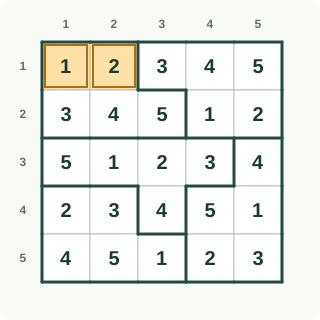
Thick borders divide the board into regions, sometimes called blocks or cages. Count the cells inside a region to find its allowed numbers. A three-cell region contains 1, 2, and 3; a five-cell region contains 1 through 5. The numbers are a complete set, not a target sum.
The current GooferThings puzzle uses five regions of five cells each, so every region on that board contains 1–5. Other Suguru publications can include smaller regions. Apply the size rule to the board in front of you rather than assuming every outlined shape always needs five numbers.
Use each region number exactly once
Within a region, a number cannot repeat even when its cells are far apart. Once 4 appears in a five-cell region, no other cell in that region can be 4. A given digit is part of this complete set and remains fixed while you fill the other cells.
Do not add the digits as if solving Kakuro or Calcudoku. A region's size defines its set directly. There is no arithmetic operation to interpret and no printed sum that needs distributing among the cells.
Check all eight neighbouring positions
A cell can have up to eight neighbours: above, below, left, right, and the four diagonals. None can contain the same number. This condition crosses thick borders, so placing a digit can restrict several other regions as well as its own.
At a boundary there are fewer neighbours, but the rule is unchanged. A diagonal touch is just as restrictive as sharing a side. Check the corners around every new entry deliberately; overlooking one diagonal conflict is among the easiest ways to spoil an otherwise sensible solve.
Know what rows and columns do not require
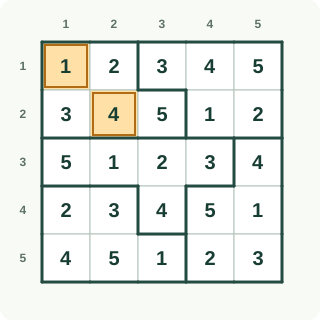
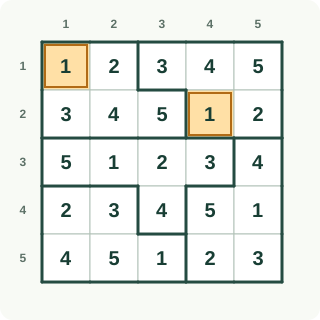
Suguru has no rule that each whole row or column must contain every number once. Equal numbers may appear in the same row when they are far enough apart, belong to different regions, and do not touch. A valid row can therefore contain repeats.
If you know Sudoku, keep its row, column, and box habits separate from this puzzle. Suguru combines outlined-region uniqueness with immediate-neighbour restrictions. Applying a whole-row exclusion to a distant cell would remove a legal candidate and could create a false solution path.
Distinguish a candidate from an entry
A candidate is a number that has not yet been ruled out. Begin with the cell's region set, remove numbers already used in that region, then remove numbers appearing in touching cells. A single surviving candidate gives a confirmed entry.
Several candidates mean the square is still unresolved. They are alternatives, not numbers to place together, and the absence of a visible conflict does not prove one candidate correct. You need a reason that excludes the others or a region-level requirement fixing that digit's position.
Use the solved diagram as a rule audit
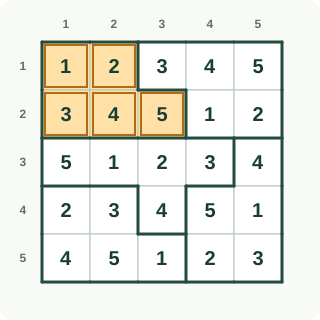
Check every outlined region separately and compare its digits with the full set 1 through its size. Then inspect touching pairs across each border, including diagonals. These two passes cover different restrictions: region uniqueness reaches farther than neighbourhood checking within an irregular shape.
A complete grid can pass one check while failing the other. A number repeated at distant ends of one region breaks the region rule; equal digits in different neighbouring regions break the no-touch rule. Name the exact failure before correcting an entry.
Names and a sourced origin note
Suguru is also published as Tectonic or Number Blocks. In its own Suguru introduction, publisher Puzzler credits Japanese puzzle compiler Naoki Inaba and says its team first encountered the puzzle in 2011. The linked primary publisher source explains the region and diagonal-neighbour rules.
The names describe this number-region puzzle family, not an arithmetic variant. They also distinguish Suguru from similarly named Sudoku. When moving between publications, read the region sizes and any explicitly stated variant rules before importing assumptions from a previous board.
Practise the rules in a playable puzzle
Play Suguru free and check every entry against both its region and all touching cells. Start with a square whose allowed set has become small. After entering a digit, revisit its region and neighbouring regions because the same entry changes both types of constraint.
Use the beginner guide for a worked solving sequence, or the strategy guide for region singles, pairs, and common-neighbour deductions. Sudoku practises candidate elimination, Futoshiki adds inequalities to number placement, and Star Battle offers another region puzzle with diagonal restrictions.
A solved example: check every rule
This completed example satisfies every puzzle rule. The individual highlights below identify the cells or edges that demonstrate each rule.
Thick outlines mark regions. Orange outlines show new digits; equal digits are excluded from all eight neighboring cells. Tinted squares remain undecided.
Sources and background
Frequently asked questions
Can equal Suguru digits touch diagonally?
No. Diagonal contact is forbidden just like horizontal or vertical contact, even across region borders. Check all eight possible neighbours of a newly entered digit.
Does every Suguru region contain 1–5?
Only five-cell regions do. In general a region of N cells contains 1 through N. The current GooferThings board has five-cell regions throughout, so its regions all use 1–5.
Can a Suguru row repeat a number?
Yes, when the repeated digits do not touch and are in different regions. There is no whole-row or whole-column uniqueness rule as in Sudoku.
Is Suguru the same as Tectonic?
Those names commonly refer to the same region-and-neighbour puzzle family, also called Number Blocks. Check the displayed rules for any special variant, especially when region sizes differ.